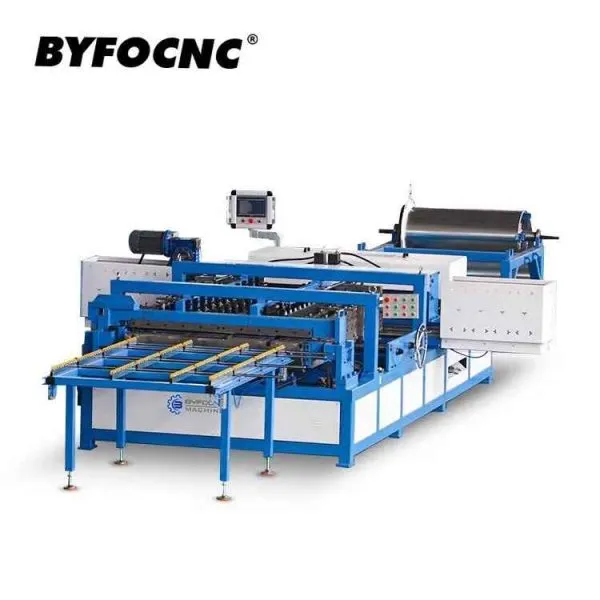

——Avoid the trap of “theoretical values”
When choosing a duct production line, manufacturers often offer tempting “theoretical production capacity” – such as “3000 square meters per day”. But after the equipment is put into operation, the actual output is often greatly reduced. Theoretical value ≠ actual value. Only by understanding this gap can you accurately calculate investment returns and arrange production reasonably.
1、 Theoretical capacity: the ideal ‘ceiling’
Theoretical production capacity is based on the following assumptions:
-The equipment runs continuously at full speed
-No material change, no specification change, no malfunction
-Perfect raw materials and skilled personnel
Example: A production line with a forming speed of 15m/min produces air ducts with a length of 1.5m and a circumference of 3.2m
-10 sections/minute * 3.2㎡=32㎡/min
-Theoretical daily production capacity (8h)=32*60*8=15360㎡
In reality, it is almost impossible to achieve.
2、 Six hidden killers of actual production capacity
| Influence factor | Typical duration | 8-hour cumulative loss |
| Start up/self-test | 5min each time | 5min |
| Change coils (4-6 times) | 3-5min each time | 20min |
| Change specifications (2-4 times) | 10-30min each time | 40min |
| Clear up scrap | 5min each time | 10min |
| Glitch /stuck material | 5-15min each time | 15min |
| Total | – | About 90min |
The effective production time is only 6.5 hours left, resulting in a loss of nearly 19%.
In addition, the actual operating speed is often reduced to 50% -90% of the theoretical value due to thick plates, stainless steel, and large duct diameters; The proficiency of personnel and the quality of raw materials will further drag down production capacity.
3、 Rapid estimation of actual production capacity
Simple formula:
Actual daily production capacity = theoretical daily production capacity * comprehensive efficiency coefficient (OEE)
| Factory level | Comprehensive efficiency coefficient |
| Excellent automated factory | 0.65-0.75 |
| General processing plant | 0.50-0.60 |
| Novice/poor management | 0.35-0.45 |
Example: Theoretical production capacity of 15360㎡*0.55 = approximately 8450㎡/day
Sub item calculation method (more accurate):
Effective time = total time – startup – material change – specification change – malfunction – clearing
Example: The effective time of an 8-hour shift is 370 minutes, the actual average speed is 11m/min, the total length is 4070m, the circumference is 3.2m → the actual production capacity is 13024㎡ (15% lower than the theoretical value).
Capacity differences for different product types:
| Product type | Relative capacity(straight duct = 100%) |
| Straight duct + TDF flange | 85-90% |
| Special-shaped parts (elbow/three-way) | 30-50% |
| Spiral duct | 120-150% |
4、 How to avoid being misled by “theoretical values”?
1. Request the manufacturer to provide actual case data: Actual daily production of customers of the same type, time to change specifications, etc.
2. On site inspection: Observe the actual operating speed and stability of the equipment with your own eyes.
3. Inquire about bottleneck: Does the cutting speed match the forming speed? Is the loading and stacking automatic?
4. The acceptance criteria stipulated in the contract are as follows: “When processing 0.8mm galvanized sheet and changing specifications ≤ 3 times a day, the actual production capacity within 8 hours shall not be less than X square meters.
5、 Practical tips for improving actual production capacity
-Optimize production scheduling: Concentrate production of the same specifications to reduce the number of specification changes
-Enhance operational skills: Rapid mold change training, establish SOP
-Equipment maintenance: Daily maintenance to reduce malfunctions
-Automation upgrade: Automatic feeding, rapid mold change, MES monitoring
6、 Conclusion
The actual production capacity of the air duct production line is usually only 50% -70% of the theoretical value. Before procurement, it is necessary to verify the real case data and specify the acceptance indicators in the contract. Only by making decisions based on actual production capacity can investment returns be accurately calculated, avoiding insufficient production capacity or resource waste.
BYFO provides standardized production capacity data without inflating theoretical values. We can arrange on-site inspections for customers and provide 8-hour continuous production acceptance, with actual output as the delivery standard.
Do you need to calculate the actual production capacity for your product?
Welcome to contact the BYFO technical team for a free evaluation report.