
——A revolutionary solution to improve efficiency and accuracy

In the field of air duct processing, branch pipe connections and air outlet openings have always been key links that affect production efficiency and product quality. The traditional processing methods usually rely on manual marking, cutting by cutting machines, or punching by punching machines, which not only have low efficiency but also difficult to guarantee accuracy.With the development of automation technology, plasma cutting and plasma punching technology are completely changing the production method of air duct accessories. As a professional manufacturer of duct equipment, BYFO will provide you with a detailed analysis of the application value of these two technologies in duct processing.

Ⅰ. What are plasma cutting and plasma punching?
1.1 Plasma cutting principle
Plasma cutting is a processing method that uses the heat of high-temperature plasma arc to locally melt metal and simultaneously blow away the molten metal with high-speed airflow to form a cutting seam. Its core advantages lie in:
-Small heat affected zone: neat cutting edges and minimal deformation
-Fast cutting speed: up to 6000mm/min
-Widely applicable materials: carbon steel, stainless steel, galvanized sheet, aluminum sheet can all be processed
1.2 Principle of plasma punching
Plasma punching is actually a special application of plasma cutting – by controlling the cutting torch through a numerical control system, circular, square or other shaped holes are cut on the plate for installing air vents, valves or connecting branch pipes.
Ⅱ. Pain points of traditional drilling methods
Before the introduction of plasma technology, air duct processing plants mainly used the following methods:
| Processing method | Shortcoming |
| Manual marking + cutting machine | Poor accuracy, low efficiency, requires skilled workers, and large hole position deviation |
| Puching machine | Custom molds required, time to change mode, and cannot process irregular holes |
| Laser cutting | Expensive equipment, high operating costs, and complex maintenance |
These traditional methods often become production bottlenecks when facing orders with non-standard sizes, irregular openings, small batches but multiple specifications.
Ⅲ. Three major applications of plasma cutting technology in air duct processing
3.1 Branch pipe connection opening
Opening branch pipe connection ports on the main pipeline is a common requirement in ventilation systems. Plasma cutting can:
-Accurately control the opening size: the error is controlled within ± 0.5mm to ensure a perfect match between the branch pipe and the main pipe
-Arbitrary shape cutting: Whether it is a circular, elliptical, or square interface, it can be completed in one programming session
-Smooth edges: No need for secondary trimming, reducing labor costs
Application scenarios: Ventilation system branch pipe connection, dust removal system pipeline interface
3.2 Openings for air supply/return ports
For commercial buildings and clean workshops, the layout of air vents is often irregular. Plasma technology can achieve:
-Batch Hole Consistency: Multiple air vents with identical sizes ensure the aesthetic appeal of the decoration
-On site adjustment function: The opening position and size can be adjusted at any time through programming to adapt to on-site changes
-Non burr cutting: Avoiding burrs generated by traditional cutting from affecting airflow and cleaning
Application scenarios: Mall air conditioning systems, cleanroom air outlets, subway station ventilation openings
3.3 Processing of irregular pipe fittings
In addition to punching holes, plasma cutting can also be used to process various shaped pipe fittings:
-Y-shaped tee
-Reducer joint
-Elbow unfold and material cutting
A plasma device combined with layout software can replace multiple sets of mechanical molds.
Ⅳ. Plasma punching technology: the perfect partner for the production of common flanges
In the production of common flange ducts, it is necessary to punch holes at the edge of the plate for installing bolts or hanging bars. The traditional method requires specialized hydraulic punching machines and frequent mold changes. The introduction of plasma punching technology has brought revolutionary changes:
4.1 Non molded punching
-No need to replace the mold: the shape and spacing of the holes can be changed through programming
-Suitable for a variety of aperture sizes: circular holes ranging from 6mm to 20mm, or long or square holes that can be switched freely
-High positional accuracy: The distance error between holes is extremely small, making it easy to install on site
4.2 Integration of cutting and punching
Modern plasma machining centers can integrate cutting and punching into the same process:
1. The plate enters the equipment
2. Cut the flange corners or reinforcing ribs
3. Punch the hole (bolt holes, hanging bar holes)
4. Cut the air outlet or branch pipe interface
The entire process is automated, without the need for secondary positioning, resulting in an efficiency improvement of over 50%.
4.3 Reduce material waste
By optimizing the nesting software, plasma equipment can reasonably arrange hole positions and cutting paths on the board, maximizing the utilization of raw materials. For air duct processing plants, a 3% -5% increase in material utilization means significant cost savings.
Ⅴ. Plasma technology vs. traditional process: data comparison
| Comparative dimension | Traditional process (handmade + punching machine) | Plasma cutting/punching |
| Single hole machining time | 2-3 minutes (including mold changing and positioning) | 10-30 seconds (automatically completed) |
| Change specification time | 15-30 minutes (mold changing) | 1-2 minutes (program calling) |
| Machining accuracy | ±2mm | ±0.5mm |
| Machinable shape | Circular as primary | Any shape |
| Artificial demand | 1-2 skilled workers | One general worker can operate multiple machines |
| Material utilization rate | Around 85% | 92% or above |
Ⅵ. The advantages of BYFO plasma solution
As a professional manufacturer in the field of air duct equipment, BYFO provides plasma cutting/punching integrated equipment with the following characteristics:
6.1 Specialized Control System
-Built in library of commonly used duct opening parameters
-One click call for standard air vents and flange hole templates
-Support direct import of DXF drawings
6.2 High precision transmission
-Adopting precision linear guide and gear rack transmission
-Positioning accuracy of 0.1mm, repeated positioning accuracy of 0.05mm
-Smooth high-speed operation and good cutting section quality
6.3 Dust removal and environmental protection design
Equipped with a water bed or smoke purification device
Compliant with environmental emission standards
Improve the working environment in the workshop
6.4 Seamless integration with existing production lines
BYFO plasma equipment can:
-Independent use: as a standalone punching device
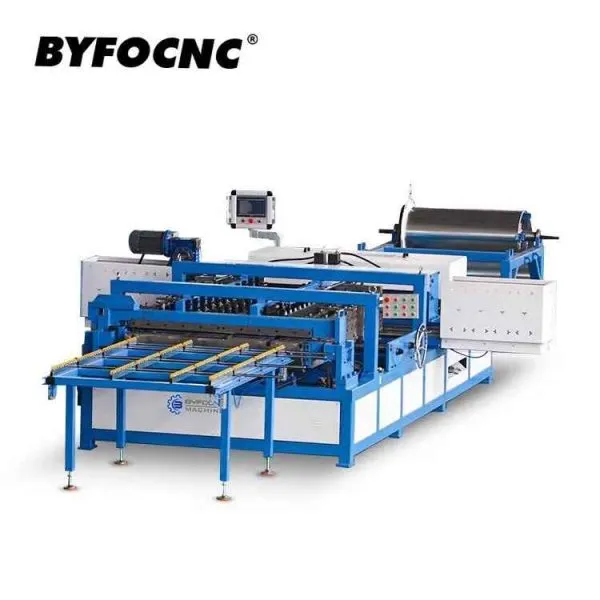
-Online use: linked with common flange machine and spiral duct machine to form a complete production line
-Expansion and upgrade: Support for adding automatic loading and unloading devices in the future
Ⅶ. Investment return analysis
Taking a medium-sized air duct processing plant as an example:
-Daily punching quantity: 300-500 pieces
-Labor cost: Traditional methods require 2 skilled workers, while plasma methods require 1 general worker
-Annual labor savings: approximately 80000 to 100000 RMB (According to the local price level)
-Material savings: Annual consumables of 200 tons, increased utilization rate by 3%=6 tons of steel ≈ 30000 to 40000 RMB (According to the local price level)
-Equipment investment payback period: 8-14 months
More importantly, plasma technology enables factories to undertake high-precision, irregular parts, and complex orders, which typically have higher profit margins.
Ⅷ. Conclusion
In today’s increasingly competitive air duct processing industry, efficiency is profit, and accuracy is competitiveness. Plasma cutting and punching technology has evolved from an “optional configuration” in the past to a “standard capability” for modern air duct processing plants.
For air duct production enterprises that want to increase production capacity, reduce labor dependence, and undertake high-end orders, investing in a high-performance plasma processing equipment is a wise choice with extremely high return on investment.
BYFO provides a complete solution from single machine plasma cutting to fully automatic air duct production line. Whether you need to upgrade existing equipment or plan a new digital workshop, we can provide you with professional technical support and customized solutions.

Do you want to know how plasma equipment can be adapted to your production line? Welcome to contact the BYFO technical team, we will provide you with free process evaluation and equipment selection suggestions.