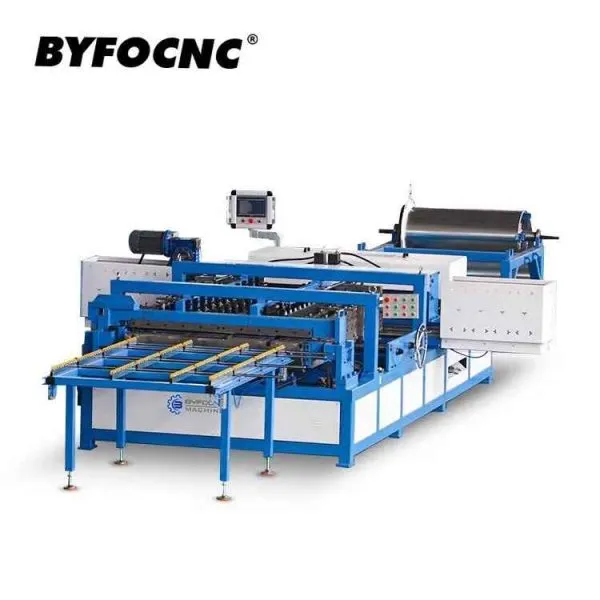

In ventilation duct engineering, flange connections are the most common interface method. Traditional angle steel flanges require additional welding of angle steel, drilling, and bolting, which is cumbersome and costly. However, common plate flange (TDF flange) technology directly forms the flange edge onto the duct plate, and the connection is completed using corner codes and bolts, eliminating the need for angle steel materials and multiple processes.
BYFO TDF flange forming machine is the core equipment for realizing this efficient process. This article will detail its working principle, advantages, selection points, and application scenarios.
I. What is the common plate flange?
Common plate flange, also known as TDF flange, is a method of directly forming the flange edge at both ends of a duct using a rolling forming process, and then fixing the two duct sections together using flange corner codes and bolts.
Comparison with traditional angle steel flange:
| Comparison item | Angled steel flange | Common plate flange (TDF flange) |
| Flange material | Angled steel(need be purchased, cut, and welded separately) | Ductwork panel itself(no additional materials) |
| Processing step | Material cutting, welding, drilling, grinding | One-time roll forming |
| Installation speed | Slow(many bolts, difficult to align holes) | Fast(angle code positioning, fewer bolts) |
| Sealing performance | Good(sealing gasket is needed) | Good(seal strip can be added) |
| Strength | High(suitable for high pressure) | Medium-high(suitable for medium and low pressure) |
| Cost | High(materials + labor) | Low(save angle steel and welding) |
II. Working principle of BYFO common plate flange forming machine

The equipment uses multiple sets of rollers to gradually roll the edges of duct sheet metal into a specific flange shape. Main Process:
1. Sheet feeding: Pre-cut duct sheet metal (or online) enters the equipment.
2. Pre-bending: The first set of rollers folds the edge of the sheet upwards at a certain angle.
3. Flange forming: Subsequent rollers gradually press the rolled edge into a “T” or “C” shaped cross-section, forming the flange flange.
4. Angle punching/cutting (optional): Angle code installation notches are punched at both ends of the flange, or it is cut as needed.
5. Discharge: The formed duct end has a complete common plate flange.
Key components:
• Roller set: Multi-pass precision rollers, made of GCr15 bearing steel, quenched, with long wear resistance and service life.
• Adjustment mechanism: Adjustable flange height and width to accommodate different plate thicknesses (0.5-1.5mm).
• Drive system: High-torque geared motor ensures smooth forming of thick plates.
• Control system (optional): PLC + touch screen, automatically controlling length and punching position.
III. Core advantages of BYFO TDF flange forming machine
3.1 Material cost savings
• No need to purchase angle steel; forming is done directly using the plate material itself.
• Save approximately 10-20 CNY per meter of ductwork (based on current steel prices).
• For a factory producing 100,000 meters of ductwork annually, this translates to annual material cost savings of 100,000-200,000 CNY.
3.2 Increased production efficiency
• Processing speed is 3-5 times faster than traditional welded angle steel flanges.
• Forming speed can reach 10-15 meters/minute (flange edge), enabling automated operation in conjunction with production lines.
• Reduces reliance on skilled welders; ordinary workers can operate the machine.
3.3 Easy Installation
• Common plate flange ductwork is lightweight (no additional angle steel), making handling and hoisting easier.
• During installation, simply insert the corner code into the groove of the flange edge, thread the bolt and tighten it, without adjusting to align holes.
• Installation efficiency is more than 50% higher than angle steel flanges.
3.4 Excellent sealing performance
• Sealing strips (neoprene rubber or EPDM) can be embedded between the flange edges, resulting in good airtightness after compression.
• Suitable for medium and low pressure air conditioning ventilation and smoke exhaust systems, with leakage rate meeting specifications.
3.5 High standardization
• Flange dimensions conform to general standards.
• Corner codes, bolts, and other accessories are universal and readily available in the market.
IV. Selection points
| Parameter | BYFO recommend | Explanation |
| Processing plate thickness | 0.5–1.5 mm (galvanized sheet); 0.5–1.2 mm (stainless steel) | Choose based on commonly used materials;Stainless steel need enhanced type |
| Flange height | 30–35 mm (adjustable) | Common air duct flange height |
| Forming speed | 10-15 meters/minute | Depend on the plate thickness and material |
| Plate width | ≤1250mm or ≤1500mm | Match the common coil material width |
| Control method | Manual/electric/CNC available | Manual mode is suitable for standalone operation, while CNC mode is suitable for online automation |
| Online function | Can be connected to air duct production line | The process of uncoiling→leveling→ribbed→notching→TDF flange forming→cutting is fully automated |

BYFO Recommended Configurations:
• Economy type: Manually adjustable, for independent use, suitable for small and medium-sized processing plants.
• Automatic type: Electrically adjustable flange height, touchscreen control, suitable for mass production.
• Online type: Seamlessly integrates with fully automated duct production lines for unified production.
V. Application scenarios
• Central air conditioning duct system: Medium and low pressure air supply ducts for commercial buildings, office buildings, and shopping malls.
• Fire exhaust system: Exhaust ducts requiring flange connections but with relatively low pressure.
• Fresh air system: Fresh air ducts for residential or public buildings.
• Industrial ventilation: General factory workshop ventilation, without strong corrosion or high-pressure requirements.
VI. Cost comparison with traditional angle steel flange (real case)
Taking a medium-sized duct processing plant as an example, with a monthly output of 10,000 meters of rectangular ductwork (average 800×500mm).
| Item | Angled steel flange | TDF flange (BYFO) |
| Angle steel material (per meter) | 2.5kg × 4.5 CNY/kg = 11.25 CNY | 0 CNY |
| Welding labor (per meter) | 0.8 CNY | 0 CNY |
| Drill hole/Bolt/Corner code | 2.0 CNY | 2.5 CNY (corner code+bolt) |
| Sealant strip | 1.0 CNY | 1.0 CNY |
| Comprehensive cost per meter | 15.05 CNY | 3.5 CNY |
| Monthly cost | 150,500 CNY | 35,000 CNY |
| Monthly saving | – | 115,500 CNY |
Even after deducting equipment depreciation and maintenance, it is entirely possible to recoup the cost in one month.
VII. Maintenance and upkeep
• Daily: Clean the surface of the rollers and remove metal debris; Check the lubricating oil level.
• Weekly: Check all fastening bolts to prevent loosening; Observe the wear of the rollers.
• Monthly: Add lubricating grease to the transmission chain/gear; Check the tension of the motor belt.
• Every six months: Conduct a comprehensive inspection of the wear of the rollers and replace them if necessary; Calibrate the flange height adjustment mechanism.
Vulnerable parts: Rollers (normal lifespan of 500,000 to 1 million meters), transmission chain, bearings. BYFO provides long-term supply of original factory accessories.
VIII. Frequently asked questions and answers
Q: Can TDF flange be used in high-pressure systems?
A: It is usually recommended for medium and low pressure systems with a pressure of ≤ 1500Pa. At higher pressures, it is recommended to use angle steel flanges or enhanced type TDF flanges (increasing flange height or installing enhanced angle steel).
Q: Can stainless steel plates be processed with it?
A: Sure, but enhanced equipment needs to be selected because stainless steel has a large rebound and high forming force requirements. BYFO provides stainless steel specialized rollers and higher power drives.
Q: Can I punch the corner code hole online?
A: Sure, BYFO TDF flange machine can be equipped with a hydraulic punching device, which can notch the corner code installation gap while forming the flange, further improving efficiency.
Q: Which is better compared to the non-flange socket?
A: The installation of non-flange socket is extremely fast, but its sealing and anti pull ability are weaker than those of TDF flange. Generally, circular ducts use non-flange socket, while rectangular ducts use TDF flanges.
IV. Conclusion
TDF flange technology is a significant advancement in the process of air duct connection, which has become the mainstream choice for modern ventilation engineering with lower cost, faster installation, and better standardization.
BYFO TDF flange forming machine, with high-precision rollers, stable drive, and flexible configuration options, helps customers:
• Save material costs: Save more than 10 CNY per meter of air duct
• Improve production efficiency: 3-5 times faster than angle steel flanges
• Reduce installation difficulty: Common workers can operate it
• Adapting to automated production line: helping factories achieve less manpower
If you are transitioning from traditional angle steel flanges to TDF flanges, or planning to upgrade your existing equipment, BYFO offers free process evaluations and equipment solutions. Welcome to contact us and provide your commonly used plate thickness and duct size. We will reply with a detailed plan within 24 hours.