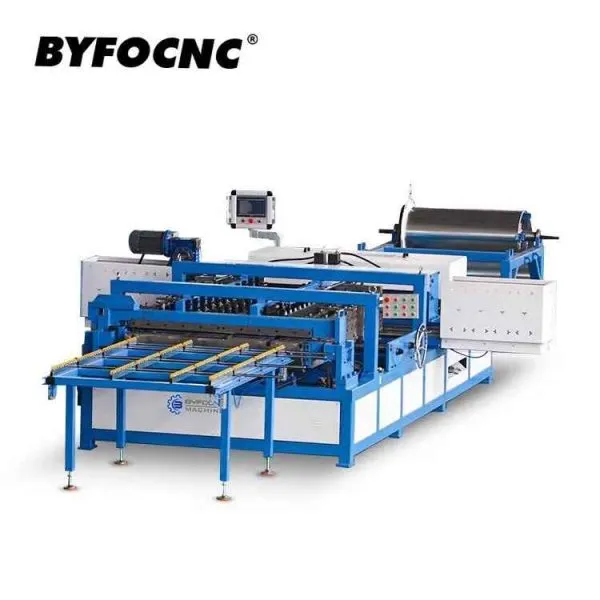


One of the biggest advantages of circular spiral ducts is their roundness. Insufficient roundness leads to problems like flanges not fitting properly, sealing strips not tightening, and excessive air leakage, making on-site installation extremely difficult.
If your duct is not round, it’s highly likely that one of the following three aspects is the problem. Checking each one will quickly resolve the issue.
I. Where did the problem lie? Three key aspects to check
Aspect 1: Unevenness of the coil material itself
Phenomenons: The edges of the coil are wavy, or the entire coil has deformed due to prolonged storage.
Causes: Raw material issues—the steel coil was compressed and deformed during transportation or storage, or it wasn’t adequately leveled after unwinding.
How to determine: Visually inspect the sheet material before feeding whether it is already wavy or twisted.
Solutions:
• Replace with coil material with better flatness
• Install a leveling device at the front end of the equipment (standard equipment on BYFO production lines)
• Use A-frame supports to store the coil material vertically to avoid deformation from flat placement.
Note: If even the leveling machine cannot level it, the coil material itself is of poor quality and should not be used.
Aspect 2: Uneven gap between forming rollers
Phenomenons: Some parts of the duct’s circumference are round, while others are flat, appearing elliptical or locally concave.
Causes: The forming rollers (rollers) are the core components controlling roundness. If the gap between the upper and lower rollers is inconsistent, or if the pressure on the left and right sides is different, the duct will be pressed off-center.
How to determine:
• Use a standard roundness test ring inserted into the duct to check the gap at various points.
• Alternatively, use a tape measure to measure the diameter in multiple directions on the same cross-section; an error >2-3mm indicates a problem.
Solutions:
• Readjust the roller gap according to the equipment manual to ensure uniformity in the circumferential direction.
• Check if the left and right rollers are symmetrical; recalibrate if necessary.
• Replace severely worn rollers.
In short: Roundness is guaranteed by the rollers; if the rollers are not round or flat, the duct will not be round.
Aspect 3: Flattened tube end during cutting
Phenomenons: The middle of the duct is very round, but the area near the end is noticeably “out of roundness.”
Causes: Improper cutting method – excessive force applied by the saw blade during cutting, or excessive clamping force of the flying cutter, deforming the thin-walled pipe opening.
How to determine: Observe the cut pipe section and check the difference in roundness between the pipe opening and the middle of the pipe body.
Solutions:
• Use chipless cutting (flying cutter): The pipe rotates while being cut, the cutter only cuts the seam, without compressing the pipe wall.
• Reduce the clamping force during cutting, just enough to grip without slipping.
• Regularly check the sharpness of the cutter; a dull blade increases resistance.
BYFO recommendation: Using flying cutter technology, even thin-walled pipe openings can maintain perfect roundness.
II. Quick Troubleshooting Checklist
| Problem phenomenon | Most likely reason | Priority check |
| The entire duct is not round | Uneven coil material | Leveling device, coil material quality |
| Local flattening in the circumferential direction | Uneven roller clearance | Adjust the roller clearance |
| Only the pipe opening is not round | Cutting and clamping deformation | Cutting method, clamping force |
| Roundness varies | Roller wear or loosening | Check the rollers’ fixing bolts |
III. Quick Self-Inspection Methods Before Leaving Factory
After the duct comes off the machine, no complicated instruments are needed. The following methods can be used to determine if the roundness is up to standard:
Method 1: Measure the diameter with a tape measure
• Measure the diameter in two intersecting directions at the same cross section of the duct.
• A difference of ≤2mm between the two values is acceptable; >3mm indicates insufficient roundness.
Method 2: Visual inspection of rolling
• Gently roll the duct on a flat surface.
• If there is significant bouncing, the roundness is problematic.
Method 3: Flange trial installation
• Place a standard flange on the duct opening.
• The gap between the flange and the duct wall should ideally be ≤1mm.
IV. BYFO’s Solution
BYFO spiral duct machines prioritize roundness control from the design stage:
| Aspect | What did BYFO do |
| Flat coil material | Standard configuring leveling device, even the worst quality coil material can be leveled. |
| Roller precision | The rolls are made of GCr15 bearing steel and precision ground, with a roundness error of ≤0.05mm. |
| Roller gap | The whole beam type adjustment mechanism uses 14 bolts that tighten synchronously, ensuring uniform clearance. |
| Cutting method | Flying cutting + chipless technology ensures no deformation of the pipe opening. |
| Self-check assistance | The machine comes with a roundness test ring to facilitate quick acceptance by customers. |
V. Summary
The roundness of ducts failing to meet standards is generally due to three reasons:
1. Raw materials: Uneven rolled material → Add a leveling device / Replace with better material
2. Equipment: Uneven roller gap → Readjust / Replace rollers
3. Cutting: Flattened duct ends → Switch to flying cut / Reduce clamping force
By checking each option, the problem is not difficult to solve. If the equipment itself lacks precision, or the rollers are severely worn, it is recommended to contact the equipment manufacturer for an upgrade or replacement solution.
Duct roundness not meeting standards?
Send a video to BYFO technical team, and we will help you diagnose the cause remotely.
Email: byfo@byfomachine.com
Whatsapp: (0086)18255536645