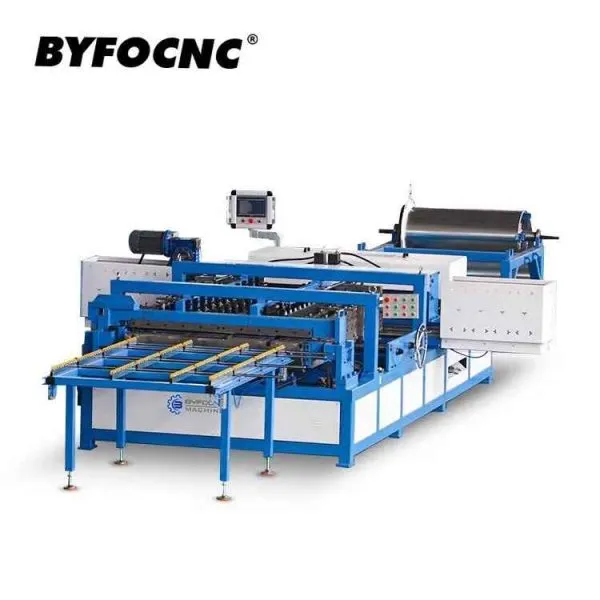

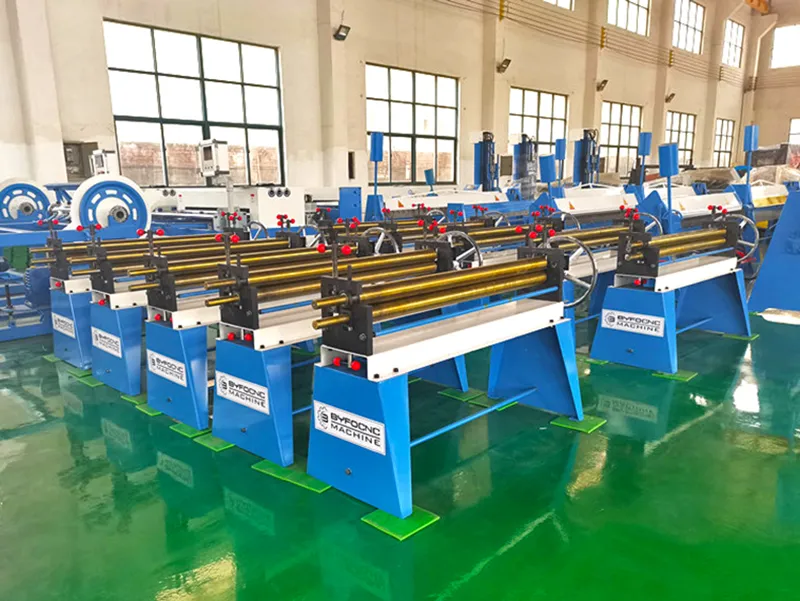
Spiral duct forming machines can efficiently produce straight ducts using continuous seam forming. However, if you need to make a separate circular duct section for patching, or process fittings such as elbows and tees, you’ll face a problem: no equipment can roll flat plates into circles. In this case, an electric plate rolling machine (also known as a three-roller rolling machine) is a highly cost-effective addition to your workshop.
I. What can an electric plate rolling machine do?
| Processing object | Function |
| Circular air duct/supplementary duct | Processing of single or multiple short pipe sections |
| Round elbow | Roll the curved quick-cut plate required for the elbow |
| Pipeline repair | No need for the entire spiral duct; rolling with a flat plate can meet the pipe replacement requirements |
| Reducer | Process conical coil plates |
| Flange ring | Roll the round flat iron for flanges |
II. Electric plate rolling machine VS manual plate rolling machine
| Comparison item | Manual plate rolling machine | Electric plate rolling machine(three-roller type) |
| Power source | Manually operate the handle | Motor-driven, with three rollers rotating synchronously |
| Rolling efficiency | Slow (waste time and energy) | Fast (complete one forming process in 10–30 seconds) |
| Continuous processing | Arms ach after rolling a few tubes | Can be continuously processed, suitable for batch production |
| Accuracy | Relying on experience, large error | Stable and controllable, good reproducibility |
| Thick plate processing | It’s almost impossible to shake if it’s over 1.2mm | Easily roll 1.5 mm galvanized sheet/stainless steel sheet |
| Impact of thickness | The thicker, the more difficult it is | Increased thickness has little impact on electric equipment |
| Operation Threshold | It requires strength and skill | Ordinary worker training will be able to |
| Price | 3,000-8,000 CNY | 10,000-30,000 CNY |
| Labour cost | It requires manual operation, inefficient | By saving one person’s labor, the investment can be recouped in about six months |
Key conclusion: Manual plate rolling machines may seem cheaper, but the labor costs over a year far exceed the equipment price difference. The extra 10,000-20,000 CNY in equipment cost for an electric plate rolling machine is recouped in labor costs within six months.
III. Four major advantages of its application in duct processing
1. Labor-saving and high-efficiency: Motor-driven, one-person operation, especially significant when producing batches of round pipes or fittings.
2. Controllable precision: Consistent roundness and dimensions are maintained even during repeated or continuous processing.
3. Wide applicability: Can process galvanized steel, stainless steel, and aluminum plates, flexibly handling different orders.
4. Small size/easy to move: The machine has a small footprint and can be flexibly placed in any area of the workshop.
IV. Essential selection guide: three core dimensions
Buying an electric plate rolling machine that is too small will result in insufficient roll width, while buying one that is too large is a waste of money. When choosing an electric plate rolling machine, please pay attention to the following three parameters:
| Parameter | Explanation | BYFO suggestion |
| Rolling plate width | The maximum plate width that the machine can roll | It is recommended to select 1300 mm or 1500 mm, covering the standard roll width |
| Maximum plate thickness | Common galvanized steel sheets 0.5–1.2 mm, stainless steel sheets 0.5–1.0 mm | A thickness of 1.5 mm meets the requirements for common plates |
| Minimum rolling diameter | Whether the rolling machine can roll small-diameter coils | The most common minimum Φ is 100–120 mm |
Why is a width allowance recommended? BYFO’s electric plate rolling machine supports plate widths ≤1500mm and processing thicknesses of 0.4-1.5mm. Choosing a wider width allows for both rolling ducts and flange rings, making one machine more cost-effective for multiple uses.
V. Operation and daily maintenance tips
· Daily: Check the surface of the three rollers for any metal shavings; run the machine idle before starting.
· Before each batch: Roll a small section to confirm roundness and seam alignment; only proceed with mass production after passing the test.
· Regular inspection: Lubricate the transmission gears and bearings (once a month); check the motor belt tension.
· Common faults: Plate slippage or failure to feed → Increase the pressure of the upper roller appropriately. Non-round after rolling → Check if the gap between the three rollers is uniform.
VI. BYFO electric plate rolling machine core parameters
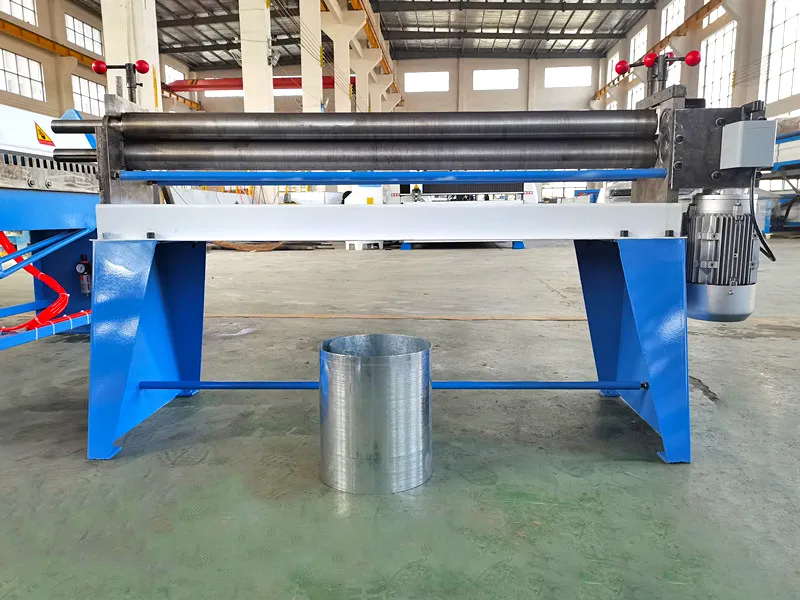
BYFO’s electric plate rolling machine uses a three-roller gear synchronous transmission, allowing the plate to feed at a uniform speed, preventing slippage and abrasion, and minimizing surface damage.
| Core parameters | BYFO configuration | Industry reference |
| Driving method | Three-roller gear synchronous transmission | Some suppliers have not yet adopted synchronous transmission |
| Processing plate thickness | 0.4–1.5 mm (both galvanized sheet and stainless steel are suitable) | Most competing products have a maximum limit of 1.2 mm |
| Maximum rolling width | 1500mm | Common range: 1000–1300 mm |
| Motor power | 0.75-1.5KW | – |
| Warranty period | 2 years, parts supply | Some competing products are only available for 1 year |
| Certification | CE/ISO certification | – |
VII. Conclusion
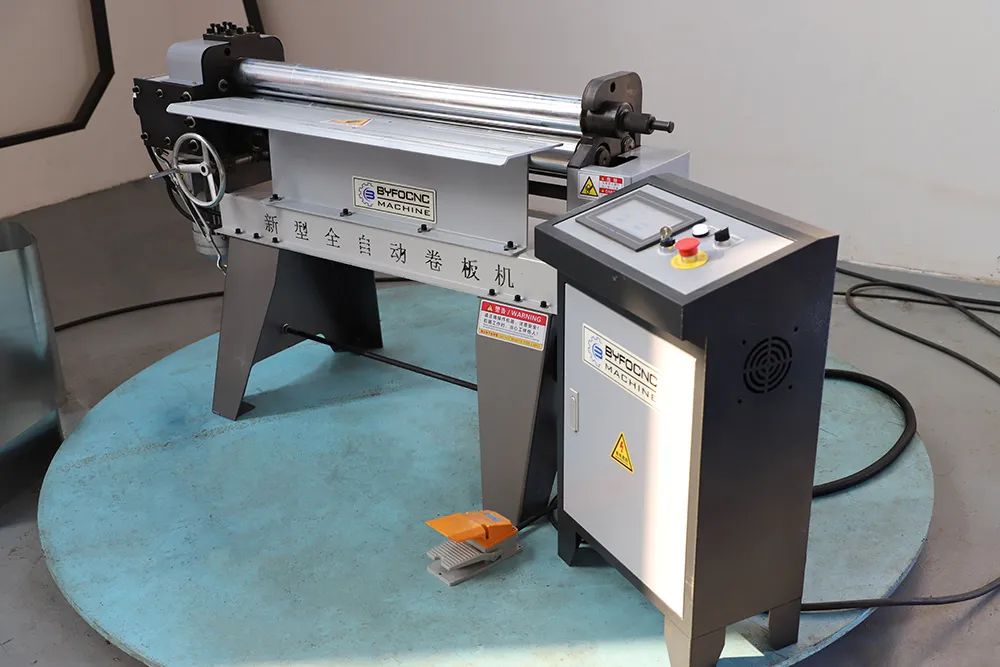
Although the electric plate rolling machine isn’t the core machine on the production line, it’s an essential auxiliary device in duct processing workshops for handling circular supplementary duct and fittings. With it, shop owners no longer need to worry about missing one section of round pipe; with it, the workshop can handle a wider variety of orders.
BYFO electric plate rolling machine is labor-saving, durable, and provides stable roundness. Its compact design is specially optimized for small processing plants, allowing it to be moved to wherever needed without occupying a fixed workstation.
Planning to upgrade the rolling process in the workshop?Contact BYFO and tell us your commonly used materials and widest possible plate width. We’ll recommend a suitable model within 24 hours.