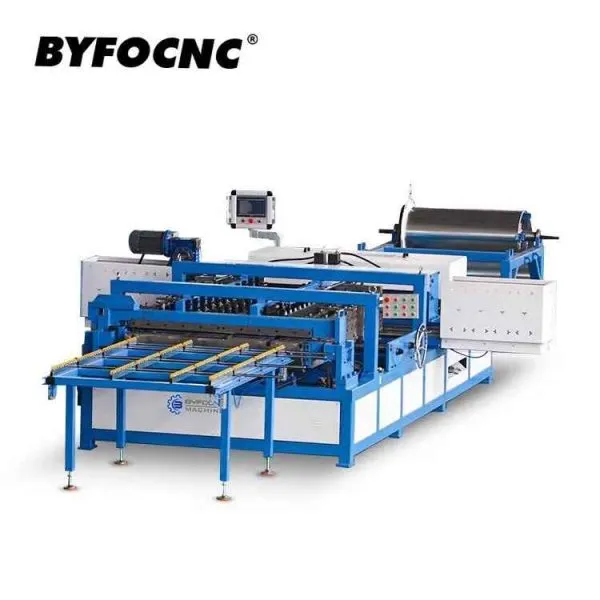

When choosing a spiral duct machine, diameter and thickness are the two most critical parameters. Choosing the wrong one, either the device cannot work, or wasting money by overusing it. Below, BYFO will help you quickly clarify the selection logic.


1、 First look at the diameter: Determine the machine specifications
| Diameter range | Recommended model | Typical applications |
| Φ80–300mm | Small-sized spiral duct machine | Household fresh air supply, local exhaust ventilation |
| Φ100–800mm | Medium-sized spiral duct machine | Commercial air conditioning, general ventilation |
| Φ200–1600mm | Large-sized spiral ducted air cooler | Industrial exhaust ventilation, underground garage, tunnel |
| >1600mm | Extra-large/non-standard customization | Large-scale factory buildings, dust removal systems |
Principle: The maximum processing diameter of the equipment should cover your commonly used specifications and leave a 10% margin.
2、 Then look at the thickness: Determine power and rigidity
| Thickness range | Equipment requirement | Suitable material |
| 0.4–0.8mm | Standard model is sufficient | Galvanized sheet, aluminum plate |
| 0.8–1.2mm | Enhanced rack design and higher-power motor required | Galvanized sheet, stainless steel |
| 1.2–1.5mm | Heavy-duty model, high-strength rollers | Stainless steel, thick galvanized sheet |
| >1.5mm | Custom heavy equipment | Special requirements |
Principle: For every 0.2 mm increase in thickness, the difficulty of forming increases significantly. Processing 1.0mm stainless steel is more difficult than 1.2mm galvanized sheet.
3、 The influence of material cannot be ignored
| Material | Model selection recommendation at the same thickness |
| Galvanized sheet | Standard configuration is sufficient |
| Stainless steel | Upgrades required: cemented carbide tools, increased forming force, reinforced frame |
| Aluminum plate | Suitable for standard models, but requires anti-scraping treatment for roller surfaces. |
4、 Quick selection table (galvanized sheet as an example)
| Diameter | Thickness ≤0.8mm | Thickness 0.8-1.2mm | Thickness 1.2-1.5mm |
| ≤300mm | Small-sized machine | Medium-sized machine | Medium-sized machine reinforcement |
| 300-800mm | Medium-sized machine | Medium-sized machine reinforcement | Large-sized machine |
| 800-1600mm | Large-sized machine | Large-sized machine reinforcement | Extra-large |
5、 Common selection misconceptions
1. Focus solely on diameter without considering thickness
Large diameter and thin plate may not be a problem, but small diameter and thick plate (such as Φ 200 mm + 1.2 mm) pose a great challenge to the equipment and require heavy machinery.
2. Ignore the “hardness” of stainless steel
For the same thickness, the forming force required for stainless steel is more than 1.5 times that of galvanized sheet.
3. No margin left
Long-term full load operation of the equipment will accelerate wear and tear. It is recommended that the commonly used specifications do not exceed 80% of the maximum capacity of the equipment.
6、 One sentence suggestion from BYFO
-Conventional ventilation (diameter ≤ 800 mm, thickness ≤ 1.0 mm galvanized sheet) → Standard medium-sized spiral duct machine
-Including stainless steel or thick plates (1.0-1.5 mm) → Reinforced or heavy-duty models
-Ultra small or ultra large diameter → Consultation for professional customization
Do you need to quickly match the model to your product parameters? Welcome to contact the BYFO technical team. Provide us with diameter, thickness, and material, and we will recommend solutions to you within 24 hours.