
——BYFO Practical Guide
In the air duct processing industry, small processing plants (including start-ups, engineering support plants, and regional processing points) occupy an important market share. They are flexible, serve the local community, and respond quickly, but they also face common challenges: limited funds, tight venues, fluctuating orders, and insufficient manpower.
How to configure a set of equipment combinations that meet current needs while leaving room for development under limited conditions? This is a question that every small duct factory operator must answer. Based on years of practical experience in serving small and medium-sized customers, BYFO has developed a practical and feasible equipment configuration plan for you.
Ⅰ. Typical characteristics and core demands of small-scale air duct factories
1.1 Portrait of a small duct factory
-Site area: 200-500 square meters (usually rented factory buildings)
-Personnel configuration: 3-8 people (the boss is often also a technical worker)
-Daily production capacity: 200-800 square meters
-Main business: Local commercial decoration, small-scale factory renovation, villa ventilation, equipment matching
-Order characteristics: Multiple specifications, small batch size, urgent delivery time
1.2 Core demands
-Controllable investment: The initial investment should not be too large, with a common budget range of 15000 to 45000 USD
-Compact footprint: Equipment layout should fully utilize limited space
-Flexible and versatile: One set of equipment can process multiple specifications, reducing the time for changing orders
-Easy to learn and use: No need for highly educated technicians, ordinary workers can get started after training
-Gradual upgrade: It is best for the equipment to expand its functions as the business grows
Ⅱ. Core equipment configuration plan (classified by business positioning)
Different business positioning corresponds to different device combinations. The following three typical configuration schemes are provided:
Plan A: Processing of universal galvanized ducts (the most mainstream choice)
Suitable for processing factories that undertake various commercial ventilation, smoke exhaust, and air conditioning ducts.
Core equipment list:
| Equipment name | Quantity | Function | Selection points |
| Auto duct production line Ⅲ | 1 set | Decoiling, levelling, beading, notching, shearing, lock forming | Choose U-shaped layout for compact space; processing plate thickness: 0.5-1.2mm; material width: 1250-1500mm |
| TDF flange forming machine | 1 set | Making TDF flange (current main connection method) | Matching with the production line to ensure flange size compatibility |
| Corner punching machine | 1 set | Producing flange angle corner | Optional and can be purchased externally |
| Folding machine (manual or pneumatic) | 1 set | Making irregular parts, flanges, and reinforcement parts | 1.5m/2m specifications, matching with the production line |
| Lock forming machine (spare) | 1 set | Manual repair materials, trimming | One set each of the pittsburgh lock and elbow lock machine (or a multifunctional lock machine) |
Plan features:
-Investment budget: Approximately 26000 to 42000 USD (depending on the degree of automation)
-Floor area: Approximately 80-120 square meters (U-shaped layout can save more space)
-Personnel requirement: 2-3 people can operate
-Daily production capacity: 600-1500 square meters
BYFO recommendation:
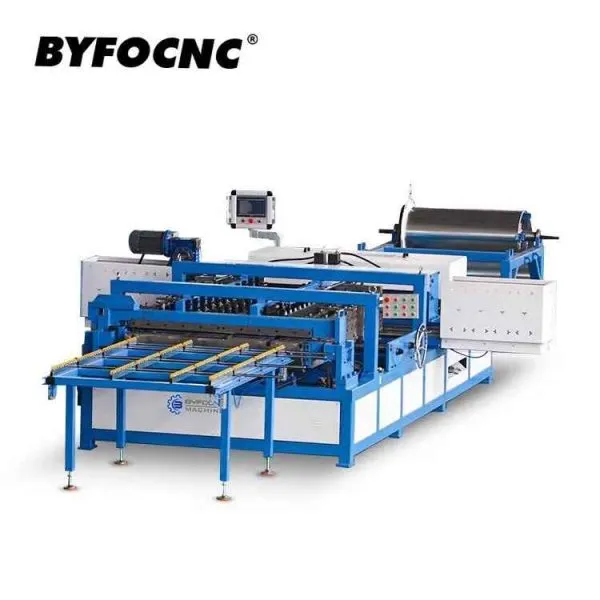
BYL-1300 fully automatic air duct production line adopts a compact U-shaped design, integrating decoiling, levelling, beading, notching, shearing, lock forming, and flange forming into one, requiring only 2 people to operate. It is an ideal starting equipment for small air duct factories.
Plan B: Processing of irregular parts/special materials (differentiated competition)
If you mainly undertake orders with high material and precision requirements for stainless steel ducts, clean room ducts, hotel kitchen smoke exhaust, etc., you need to add the following equipment on the basis of Plan A:
New core equipment:
| Equipment name | Function | Selection points |
| Plasma cutting machine | Cutting of stainless steel/galvanized sheet irregular parts | Cutting thickness 0.5-3mm, equipped with water bed dust removal |
| Welding machine | Stainless steel welding | Suitable for thin sheet welding |
| Rolling machine | Making round ducts or elbows | Three-roller symmetrical, and processing thickness is 0.5-2mm |
Plan features:
-Additional investment: Approximately 7000 to 18000 USD
-Competitive advantage: Able to take orders that others cannot do, with higher profit margins
-Attention: Plasma cutting will produce smoke and dust, and environmental protection treatment should be considered
BYFO recommendation:
BY-1340 plasma cutting machine, optimized for air duct processing, with built in commonly used air duct opening templates, cutting accuracy of ± 0.5mm, water bed dust removal, and compliant with environmental standards.
Plan C: Starting on a very small scale (with extremely limited budget)
If you are a newly started individual or engineering support team, you can start with a single machine combination and gradually upgrade.
Minimum configuration list:
-Shearing machine (1.2*2500mm): Used for cutting sheet metal, about 2500 USD
-Folding machine (manual/hydraulic): Used for folding square, about 1400 to 4400 USD
-Lock forming machine (pittsburgh lock+elbow): About 1400 USD
-TDF flange machine (manual feeding): About 2800 USD
-Corner punching machine (manual): About 1400 USD
Plan features:
-Total investment: 9500 to 12500 USD
-Advantages: Extremely low threshold, accepting orders first and then developing
-Disadvantages: Low efficiency, heavy reliance on manual labor, average accuracy, only suitable for small and scattered orders
Ⅲ. Core considerations for equipment configuration
3.1 The processing range should be ‘just sufficient’
The most common misconception in small factories is to pursue an excessively large processing range.
-Plate thickness: 0.5-1.0mm is commonly used in ordinary ventilation engineering, and 1.2mm is occasionally used. Choosing equipment with a maximum thickness of 1.2mm is sufficient, and there is no need to pursue equipment with a thickness of 1.5mm or more (equipment is more expensive and consumes more energy)
-Material width: The standard coil width is 1250mm, and choosing 1300mm or 1500mm specifications can cover the vast majority of orders
-Length: A section of air duct standard length is usually 1-1.5 meters, and the cutting range of the production line with a fixed length of 0.5-3 meters is sufficient
3.2 Automation level: ‘Act within our capabilities’
The degree of automation is directly proportional to investment, and small factories need to find a balance between cost and efficiency:
| Automation level | Feature | Suitable scenarios |
| Fully automated production line | Single operator, automatic feeding, forming, and cutting | Stable orders with daily demand exceeding 800㎡ |
| Semi-automatic combination | Single machine + manual connection | Orders fluctuate significantly, requiring flexible specification switching |
| Manual single machine | All manual operations | At the initial stage, tight funding and sporadic orders |
For most small factories, semi-automatic combination or small fully automatic production lines are the most cost-effective choices.
3.3 Equipment layout “compact and efficient”
Small factories are most afraid of equipment not being able to be installed, which can affect material flow.
The U-shaped layout is currently recognized as a compact solution:
-Coil enters from one end
-The production line is arranged in a U-shape
-Finished products are output from the same side
-The middle area can be used for stacking semi-finished or finished products
This layout saves more than 30% of the floor space compared to straight type.
3.4 Brand and after-sales “cannot be saved”
Small factories do not have dedicated maintenance personnel, and once equipment malfunctions, the entire line may be shut down. Therefore:
-Choose a professional manufacturer: a company specializing in the field of air duct equipment with more mature technology
-Confirm after-sales response: Can remote or on-site support be provided within 24-48 hours
-Spare parts supply: Is it easy to purchase vulnerable parts (cutting tools, molds)
Ⅳ. Suggestions for phased configuration (growth path from small to large)
For new entrepreneurs, it is not recommended to invest all the equipment at once. Here are BYFO’s suggested three-step strategy:
Phase 1: Start up period (0-6 months)
-Goal: To validate the market and accumulate customers
-Configuration: Manual shearing machine+folding machine+lock forming machine (investment about 7000 to 12000 USD)
-Strategy: Take on small and scattered orders first, and even outsource some processes
Phase 2: Growth period (6-18 months)
-Goal: Stabilize orders and improve efficiency
-Configuration: Add a small fully automatic production line or a TDF flange machine (additional investment of 14000-23000 USD)
-Strategy: Automated the production of highly repetitive straight ducts, with manual focus on irregular parts
Phase 3: Expansion period (after 18 months)
-Goal: Expand production capacity and undertake larger projects
-Configuration: Upgrade to a complete production line, add plasma cutting, automatic square folding, etc. (investment of 28000-42000 USD)
-Strategy: Establish a complete automated production capacity and expand the scope of orders to large and medium-sized projects
Ⅴ. Common misconceptions and avoiding pits guide
Misconception 1: Blindly pursuing “fully automatic” and “high-end”
Reality: Fully automated production lines are expensive and require complex maintenance. If the order is unstable, the equipment idle rate will be high and the investment return cycle will be prolonged. Calculate first, then invest.
Misconception 2: Only focus on price, not quality
Reality: Low priced machines often use inferior materials, have poor accuracy, and are prone to malfunctions. A lock forming machine is three to five hundred USD cheaper, but it may get materials stuck every few days, causing delays and even greater losses.
Misconception 3: Ignoring matching tools
Reality: With a host, it also requires matching corners, flange clamps, sealants, cradles, etc. Some small factories only realize after buying a production line that they do not have corner punching machines, and the cost of purchasing corners is high and the delivery time is uncontrollable.
Misconception 4: Unreasonable site planning
Reality: When the equipment enters the site, it is discovered that the door is too small to enter, or there is no material turnover space after the equipment is placed. Before buying equipment, draw a workshop layout plan first.
Ⅵ. BYFO’s special support for small duct factories
As a professional manufacturer of air duct equipment, BYFO understands the difficulties of small factories. We provide startup clients with:
6.1 Tailored solutions
Based on your budget, venue, and target market, provide 1-3 sets of equipment configuration plans for selection. Do not promote the most expensive ones, only recommend the most suitable ones.
6.2 Workshop layout guidance
Free equipment layout drawings are provided to help you maximize the use of limited space and plan reasonable material flow paths.
6.3 Operation training
After the equipment is delivered, provide on-site operation training to ensure that your workers can operate independently and perform daily maintenance.
6.4 Gradually upgrade channels
BYFO devices adopt modular design, with basic configuration purchased in the initial stage and functional modules added in the later stage, without the need to replace existing devices.
VII. Conclusion
There is no “only one correct” answer for the equipment configuration of small air duct processing plants, only the “most suitable” solution for you.
Core principles: Determine the process route based on market positioning, choose the degree of automation based on financial strength, optimize equipment layout based on site conditions, and reserve upgrade space according to development plans.
If you are planning your own duct processing plant, please feel free to contact BYFO company. We will provide you with free device configuration consultation to help you take a steady first step.
Do you want to obtain a device configuration plan tailored to your specific situation?
Please send us the following information:
-Expected monthly production capacity (square meters)
-Main processing materials (galvanized sheet/stainless steel/other)
-Main product types (square ducts/round ducts/irregular parts)
-Available site area
-Budget scope
BYFO technical team will provide you with a preliminary plan and equipment quotation within 24 hours.