
——BYFO Process Guide
In ventilation duct systems, biting (also known as seam locking) is the core process of connecting sheets into ducts. It may seem simple, but it directly affects the three key performance of the air duct: strength, sealing, and corrosion resistance.
Many duct processing factories often focus on equipment capacity and sheet thickness, but overlook the decisive role of bite design in the service life of ducts. A duct system originally designed for a lifespan of 10 years, if the bite design is improper or the processing quality is poor, may experience problems such as air leakage, cracking, and corrosion within 3-5 years.
This article will delve into the technical key points of biting process, helping you significantly improve the service life of air ducts by optimizing biting design.
Ⅰ. Basic principles and common types of bite
1.1 What is bite?
Bite is a process of mechanically bending, fastening, and compressing the edges of two sheets to form a firm connection. It does not require welding or riveting, relying on the plastic deformation of the metal itself to achieve connection.
The core requirements for biting:
-Mechanical strength: Able to withstand wind pressure and installation stress
-Airtightness: prevent air Leakage and reduce energy loss
-Corrosion resistance: Prevent the joint from becoming the starting point of corrosion
1.2 Common types of bite
| Bite type | Structural feature | Applicable scene | Advantages and disadvantages |
| Pittsburgh lock | One edge is bent, and two edges are interlocked | Rectangular duct straight pipe and elbow | Moderate intensity, simple processing, and most widely applied |
| Snap lock | One side features a card slot, the other side has a snap fastener | Light ventilation system | Quick to install, but with lower strength; use with caution in high-pressure systems |
| C cleat&S lock | Flipped edges on both sides with a connecting cleat in the middle | On-site splicing and renovation project | Flexible and convenient, but with average sealing performance |
| Elbow bite | Bite form specifically designed for elbows | Bends, tees, and other irregular-shaped fittings | Adapted to curved surface connection , high process requirements |
| TDF flange bite | The sheets are directly formed into flange edges | Medium and high pressure air duct system | High strength, excellent sealing, and integral flange forming |


Ⅱ. The four major impacts of bite design on the lifespan of air ducts
2.1 Impact 1: Structural strength
During operation, air ducts are subjected to various stresses such as positive pressure, negative pressure, vibration, and temperature changes. Bite is the weakest part of the air duct and also the area of stress concentration.
Improper design behavior:
-Insufficient bite depth → easy detachment under wind pressure
-Insufficient number of bite layers → insufficient strength, long-term vibration leads to fatigue cracking
-Deviation in bite angle → uneven force distribution, excessive local stress
Optimization plan:
-Choose the bite form based on the pressure of the air duct usage:
-Low pressure system (≤ 500Pa): Pittsburgh lock can meet the requirements
-Medium pressure system (500-1500Pa): It is recommended to use reinforced bite or TDF flange
-High pressure system (>1500Pa): must use TDF common sheet flanges or welded structures
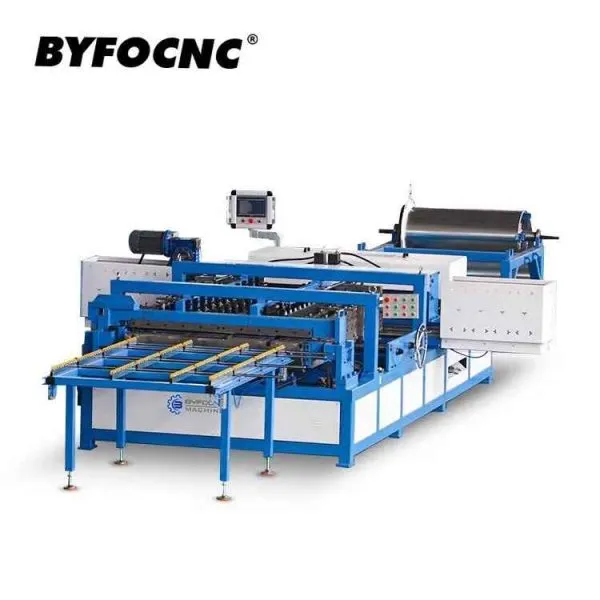
BYFO equipment adopts precision roller design to ensure consistent bite depth and accurate angle, fundamentally guaranteeing structural strength.
2.2 Impact 2: Air tightness performance
Air leakage is one of the main sources of energy loss in duct systems. Research has shown that an air duct system with poor bite quality can have a leakage rate of up to 10% -30%, which means an increase in air conditioning energy consumption and insufficient air flow at the end.
Reasons for bite air leakage:
-The bite is not fully compressed, with slight gaps present
-The rebound of the sheet causes the bite to loosen
-Improper handling of bite at corners
Optimization plan:
-Ensure sufficient compaction of the bite: Use a high-precision bite machine to ensure even pressing force
-Strengthening treatment at corners: The bite points of irregular parts such as elbows and tees should be additionally spot welded or sealed with encrypted adhesive
-Adhesive Assistance: For highly demanding systems such as cleanrooms and operating rooms, sealant can be pre applied inside the bite
BYFO lock former machine is equipped with the adjustable device, which can accurately adjust the bite tightness according to the thickness and material of the sheet, ensuring the best sealing effect.
2.3 Impact 3: Corrosion resistance performance
The core anti-corrosion layer of galvanized steel sheet is the surface zinc layer. During the bite processing, if the process is improper, it can damage the zinc layer, resulting in:
-Zinc layer peeling off at the incision and bending points
-The exposed steel sheet inside the bite begins to rust
-Corrosion spreads from the bite to the surrounding area
The beginning of corrosion often occurs at the bite point.
Optimization plan:
-Reduce damage to the zinc layer: Use rolling forming instead of stamping to minimize impact on the galvanized layer
-Avoid sharp angle bending: A too small bending radius can cause the zinc layer to crack, and a reasonable radius should be maintained
-Cut protection: Spray anti rust paint or use self-healing coating on the cutting edge
-Bite direction design: In humid environments, the bite opening should face downwards to avoid water accumulation
BYFO equipment adopts rolling forming technology to maximize the protection of the integrity of the galvanized layer and extend the service life of the air duct.
2.4 Impact 4: Cleaning and maintenance
For places with strict hygiene requirements such as food factories, pharmaceutical factories, and electronic cleanrooms, bite design directly affects the cleaning effect.
Problem bite:
-There are gaps inside the bite, hiding dirt and grime
-Burrs on the edge of the bite, trapping dust
-Unable to thoroughly clean, breeding bacteria
Optimization plan:
-Internal bite design: Fold the bite towards the outside of the air duct, with a smooth inner wall and no dead corners
-Flatness of bite: Ensure that the bite is flat without any protrusions or indentations
-Optional welding treatment: For ultra-high cleanliness requirements, weld and grind flat after biting
BYFO can provide specialized internal bite forming equipment to meet the high standard requirements of the food and pharmaceutical industry.
Ⅲ. Bite optimization strategies for different application scenarios
3.1 Commercial building air conditioning system
Features: Medium and low pressure, long-term operation, high noise requirements
Optimization focus:
-Adopting pittsburgh bite or TDF common sheet flange
-Install a sealing strip inside the bite to reduce air leakage and vibration noise
-Strengthen treatment at corners
3.2 Ventilation/smoke exhaust in industrial plants
Characteristics: High pressure, high temperature, may transport corrosive gases
Optimization focus:
-Adopting a common flange or welded structure
-Increase bite depth by 1-2mm to enhance strength
-When using stainless steel material, pay attention to passivation treatment at the bite point
3.3 Kitchen oil fume exhaust
Characteristics: Heavy oil pollution, large temperature difference, and easy corrosion
Optimization focus:
-Recommended internal bite design, smooth inner wall to reduce oil accumulation
-The bite is fully welded and completely sealed to prevent oil leakage
-Made of stainless steel material, pickled and passivated after biting
3.4 Clean Room/Operating Room
Features: High airtightness requirements, the inner wall must be smooth
Optimization focus:
-Internal bite+welding+grinding
-Apply sealant to the bite area
-100% air leakage detection
3.5 Outdoor installation of air ducts
Features: Sun and rain exposure, large temperature difference variation
Optimization focus:
-The bite opening is facing downwards to prevent rainwater from seeping in
-Apply waterproof sealant to the edge of the bite
-Choose materials with good weather resistance (such as aluminum zinc sheetd sheet)
Ⅳ. On site inspection method for bite quality
4.1 Appearance inspection
-Whether the bite is flat, without waves or twists
-Whether the edge is tightly attached and there are no gaps
-Whether there are obvious scratches or zinc layer peeling on the surface
4.2 Dimensional measurement
-Does the bite width meet the design requirements
-Is the depth of the bite uniform
4.3 Strength testing
-Press the bite with your hand and feel if it is loose
-Conduct pressure testing on the finished air duct and observe for any deformation at the bite point
4.4 Air leakage test
-Low voltage system: Lighting method (internal lighting, external observation of light leakage)
-Medium and high voltage system: Professional air leakage tester, detecting air leakage rate according to specifications
Ⅴ. BYFO’s technological advantages in bite process
5.1 High precision roller mold
The roller of BYFO bite machine adopts GCr15 bearing steel, which is precision ground and processed to ensure that each bite shape is consistent and the size is accurate. The lifespan of the mold is over 5 million meters.
5.2 Adjustable bite depth
According to different sheet thicknesses and materials, the depth of the bite can be precisely adjusted to ensure optimal connection strength while avoiding excessive rolling damage to the sheet.
5.3 Scratch resistant design
All parts in contact with the sheet are smoothed, ensuring smooth transportation and maximum protection of the galvanized layer.
5.4 Multiple bite forms to choose from
BYFO equipment can process various forms such as pittsburgh lock, snap lock, C cleat&S lock, and elbow bite, making it versatile and meeting different order requirements.
5.5 Special models for internal bite
For high demand fields such as food and medicine, BYFO provides specialized internal bite forming equipment, with smooth and seamless inner walls of air ducts that meet cleanliness standards.
Ⅵ. Conclusion
Although the bite is small, it is related to the lifespan, performance, and safety of the air duct. A high-quality bite design can ensure stable operation of the duct system over a 10-year or even 20-year lifespan; And a rough bite can lead to system failure in just a few years.
For duct processing enterprises, improving bite quality means:
-Reduce after-sales complaints and repair costs
-Win customer trust and secure more high-end orders
-Establish technological barriers and break free from low price competition
BYFO company focuses on the manufacturing of air duct equipment and is well versed in every detail of the biting process. We not only provide high-performance bite forming equipment, but also strive to help customers master bite optimization technology and enhance product competitiveness.
Want to know how to optimize bite design for your product?
Welcome to contact BYFO technical team, we will provide you with free process diagnosis and equipment selection advice.