
Material loss directly eats up profits. The loss rate of most air duct processing plants is around 5%, but through optimization, it can be completely controlled within 2%. Below, BYFO will tell you where the money is lost and how to save it.
1、 Where does the 5% loss come from?
| Loss source | Proportion | Main reason |
| Fixed length cutting tailing | 2-3% | The final section of each coil is less than one air duct section in length, forcing it to be scrapped |
| Typesetting waste | 1-2% | The cutting process for irregular components (elbows, tees) is improper |
| Process waste materials | 0.5-1% | Bite error, dimensional deviation, operational error |
| Sheet metal scratch/rust | 0.5% | Storage or handling injury |
2、 How to reduce it to 2%? Four effective moves
1. Optimize fixed length cutting to reduce tailings
-Problem: During fixed length production, there is always a section of leftover material at the end of the coil that is “not enough for one section”.
-Countermeasures:
Adopting variable fixed length: the last section is changed to a short section air duct (such as 0.8 meters, 1 meter), which does not waste
Using nesting software: automatically calculating the optimal cutting solution
-Effect: Tail material loss reduced from 2-3% to within 0.5%
2. Irregular parts nest material to improve the utilization rate of the sheet
-Problem: Manual marking of irregular parts such as elbows and tees, leaving large edges and disorderly arrangement.
-Countermeasures:
Using a plasma cutting machine and nesting software, automatically arrange multiple irregular parts tightly
The leftover corner material is used for processing small accessories such as flange corner codes and reinforcement pieces
-Effect: Layout waste reduced from 1-2% to within 0.5%
3. Reduce the rate of processing waste
-Problem: Loose bite, inaccurate size, and operational errors leading to scrap.
-Countermeasures:
Regular calibration of equipment (fixed length sensor, bite gap)
The first piece must be inspected and confirmed before mass production
Standardized training for operators to reduce human errors
-Effect: The scrap rate reduced from 1% to within 0.3%
4. Reduce damage to the plate
-Problem: The plate has to be cut off due to scratches and rust.
-Countermeasures:
When storing, place wooden pallets and cover with waterproof cloth
Use vacuum suction cups for handling to avoid scratches from forklifts
Coil material first in, first out to prevent long-term stacking and rusting
-Effect: Damage loss reduced from 0.5% to within 0.2%
3、 Investment and return
| Measure | Required investment | Annual save material cost(calculated based on an annual steel consumption of 200 tons at a rate of 5 CNY/kg) |
| Variable fixed length function | Device built-in or software upgrade | Save 3% → 0.5%: About 25,000 CNY |
| Material nesting software + plasma | 20,000 to 50,000 CNY | Save 1.5%: About 15,000 CNY |
| Training + Calibration | A small amount of working hours | Save 0.7%: About 7,000 CNY |
| Total | About 30,000 to 60,000 CNY | Save about 40,000 to 50,000 CNY annually, with the investment recovered within 6–12 months |
4、 What can BYFO do for you?
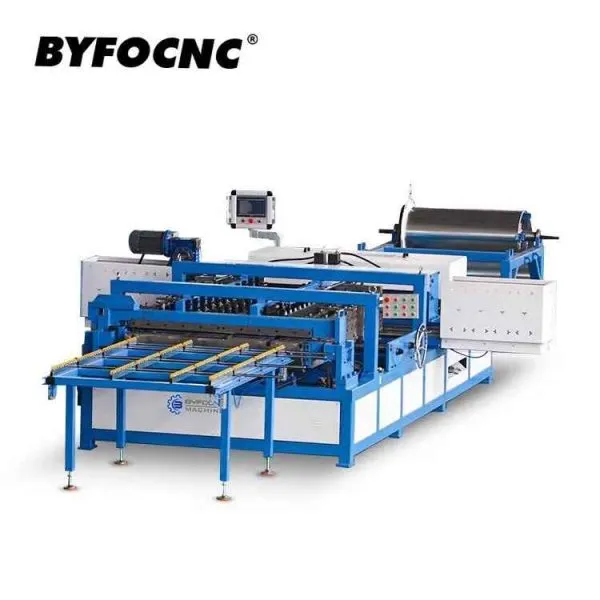
–BYFO fully automated production line supports variable fixed length cutting and automatic optimization of tailing materials
–BYFO plasma cutting machine is equipped with professional nesting software, with a layout utilization rate of over 92%
–High precision equipment (fixed length error ± 0.5mm), reducing waste
–Provide free material loss diagnosis and optimization suggestions
5、 Conclusion
Reducing from 5% to 2% can save tens of thousands to tens of thousands CNY in material costs per year. It can be achieved without changing the entire set of equipment, optimizing cutting logic, using nesting software well, and strengthening on-site management.
Want to calculate how much your factory can save? Contact BYFO to send your monthly material consumables quantity and product type, and we will provide a material saving plan within 24 hours.