
——BYFO Efficiency Guide
In the air duct processing industry, labor costs are becoming an increasingly heavy burden. Difficulty in recruiting workers, high labor costs, and high personnel turnover are challenges that every factory operator is facing.
At the same time, the market competition is fierce, and customers are becoming increasingly sensitive to prices. How to reduce costs while ensuring quality? Improving per capita output is the most direct and effective path.
The trend of “one person operating multiple devices” or “one person managing one production line” is becoming increasingly explored by more and more air duct processing factories. Is this model really feasible? What conditions are required? How much benefit can it bring? This article will provide you with an in-depth analysis.
Ⅰ. The current situation of labor costs in air duct processing
1.1 Industry average level
Taking a medium-sized Chinese air duct processing plant as an example (labor costs vary in different countries and regions):
| Job | Number of people | Monthly salary(RMB) | Annual cost(RMB) |
| Sheet metal shearing/bending | 2 | 6000 | 144000 |
| Biting/ flange forming | 2 | 5500 | 132000 |
| Forming machine operation | 1 | 7000 | 84000 |
| Welding/assembling | 2 | 6500 | 156000 |
| Carrying/assisting | 2 | 4500 | 108000 |
| Total | 9 | – | Approximately 624,000 CNY |
This does not include board and lodging, training, and management costs. For a factory with an annual output value of 3-5 million CNY, labor costs account for as much as 12% -20%.
1.2 Rising trend of labor costs
-Over the past 5 years, the average annual salary increase for general workers in the air duct processing industry has been 5% -8%
-Skilled workers are even more difficult to find, with higher salary increases
-Young people are unwilling to enter factories, and the problem of labor shortage is becoming increasingly serious
Conclusion: Controlling labor costs is no longer an “optional” option, but a “mandatory” one.
Ⅱ. The concept and principle of one person operating multiple devices
2.1 What is one person operating multiple devices?
One operator is responsible for the operation, monitoring, and simple maintenance of multiple air duct processing equipment simultaneously, achieving an efficient production mode of “people stopping but the machine without stopping”.
2.2 Core principles
One person operating multiple devices is not simply “one person doing the work of several people”, but is achieved through the following methods:
1. Equipment automation: The equipment has the functions of automatic feeding, automatic forming, and automatic fixed length cutting, and manual only requires loading and unloading and monitoring
2. Process integration: Multiple processes are integrated into one device or assembly line, reducing manual connections between processes
3. Reasonable layout: Equipment is arranged compactly according to the process flow, reducing the distance for personnel to walk
4. Intelligent monitoring: The equipment has fault self diagnosis and alarm functions, and one person can monitor the status of multiple devices simultaneously
2.3 Key premises
One person operating multiple devices is not suitable for all factories, and the following conditions must be met:
-The order is relatively stable: Frequent specification changes will take up a lot of manual time
-High degree of equipment automation: Manual equipment cannot achieve multiple machines per person
-Operators with proficient skills: Able to handle simple faults and make adjustments
-Reasonable production plan: Avoid multiple devices requiring manual intervention at the same time
Ⅲ. Feasible configuration scheme for one person multi devices mode
3.1 Plan 1: One person operation for square duct production line
Equipment configuration:
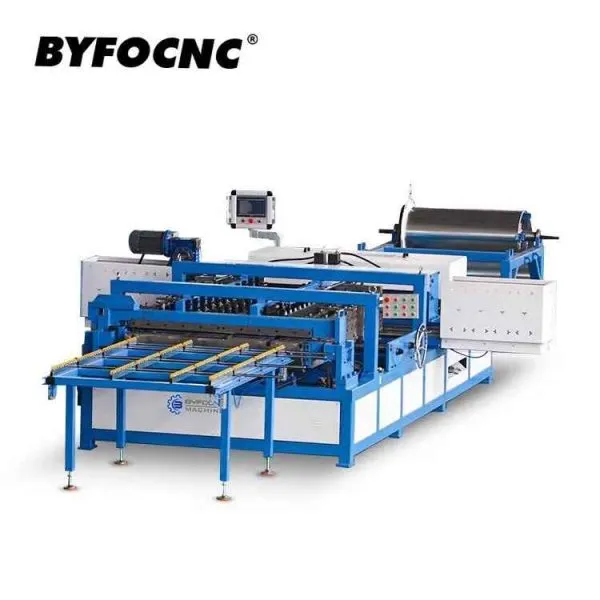
-1 set of fully automatic auto duct production line (U-shaped layout)
-Automatic stacking device
Operation content:
-Feed material coils (once every 2-4 hours, taking 5-10 minutes)
-Monitor the operational status of the equipment
-Handling simple alarms
-Finished product packaging (can be conducted synchronously during automatic operation of the equipment)
Feasibility analysis:
-Fully automated production lines do not require manual intervention during normal operation
-One person can easily operate one line and also handle simple packaging
-Skilled operators can manage 2 production lines simultaneously (with a buffer zone in the middle)
Expected per capita output: 800-1500 square meters/person/day
3.2 Plan 2: Round duct production line with one person and multiple machines
Equipment configuration:
-2-3 sets spiral duct machines
-Automatic cutting system
-Automatic unloading rack
Operation content:
-Feed material coils (staggered time for each unit)
-Set production parameters
-Monitor the operational status
-Collection of finished products
Feasibility analysis:
-Once the spiral duct machine is started, it can run continuously for 20-30 minutes without intervention
-2-3 devices with staggered loading times can be managed by one person
-Automatic unloading device needs to be configured to reduce manual handling time
Expected per capita output: 600-1000 meters/person/day
3.3 Plan 3: One person, multiple machines for processing irregular parts
Equipment configuration:
-One CNC plasma cutting machine
-One CNC bending machine
-One lock forming machine
Operation content:
-Programming and layout (can be conducted synchronously during cutting)
-Loading and unloading
-Bending and biting operations
Feasibility analysis:
-During the operation of the plasma cutting machine, personnel can perform bending or biting operations
-Through reasonable production scheduling, achieve synchronous “cutting+bending”
-Need to configure a quick mold changing device to reduce the time required for changing specifications
Expected per capita output: 200-400 square meters/person/day
3.4 Plan Four: Fully automated production line cluster
Equipment configuration:
-2-3 fully automatic auto duct production lines
-Centralized feeding system
-Central control room
Operation content:
-Centralized control of multiple devices
-Unified production scheduling and monitoring
-Automatic packaging of finished products
Feasibility analysis:
-Suitable for larger scale factories
-One person can manage 2-3 production lines
-MES system needs to be configured to achieve centralized monitoring
Expected per capita output: 2000-4000 square meters/person/day
Ⅳ. Investment return analysis of one person multi devices mode
4.1 Initial investment comparison
| Mode | Equipment investment | Labor cost(annual) | Investment difference(RMB) |
| Traditional mode (9 people) | 200,000 to 300,000 RMB | 620,000 RMB | Benchmark |
| One person one machine semi-automation (5 people) | 350,000 to 500,000 RMB | 350,000 RMB | Equipment: +150,000; Labor: -270,000 |
| One person multi devices automation (3 people) | 600,000 to 800,000 RMB | 210,000 RMB | Equipment: +450,000; Labor:-410,000 |
4.2 Calculation of payback period
Taking the one person multi devices mode as an example:
-Equipment investment increase: Approximately 450000 RMB
-Annual labor cost savings: Approximately 410000 RMB
-Other savings (management, accommodation and meals): Approximately 50000 RMB
-Annual comprehensive savings: Approximately 460000 RMB
-Investment payback period: Approximately 12 months
4.3 Implicit benefits
In addition to direct labor cost savings, the one person multi devices mode also brings:
-Reduced management costs: Reduced personnel and decreased management complexity
-Quality stability improvement: Automated equipment reduces human error
-Enhanced capacity elasticity: It is easy to increase production capacity by increasing shifts
-Reduce employment risks: Decrease reliance on skilled workers
Ⅴ. Implementation difficulties and countermeasures in the one person multi devices mode
5.1 Difficulty 1: Equipment failure handling
Problem: When one person has multiple machines, if one device malfunctions, personnel may be working on another, causing the machine to shut down and wait.
Countermeasure:
-Choose equipment with high reliability to reduce failure rates
-Configure device self diagnosis and remote alarm functions
-Establish a rapid response mechanism and keep key vulnerable parts in stock
-Train operators to master basic troubleshooting skills
5.2 Difficulty 2: Efficiency of changing specifications
Problem: When changing specifications frequently, multiple devices need to be adjusted at the same time, and one person cannot handle it.
Countermeasure:
-Adopting the “mass production” strategy and concentrating production of the same specifications
-Select rapid mold changing equipment and control the time for changing specifications within 5 minutes
-Configure formula storage function, one click retrieval of parameters
-Staggering the time for changing specifications of each device
5.3 Difficulty 3: Personnel skill requirements
Problem: One person with multiple machines requires operators to possess more comprehensive skills, which are difficult for ordinary workers to handle.
Countermeasure:
-Choose devices with user-friendly interfaces to lower the learning threshold
-Establish standardized operating procedures (SOP) to reduce reliance on personal experience
-Regular training to enhance employees’ multi skill level
-Establish an incentive mechanism for “multi skilled workers”
5.4 Difficulty 4: Material Handling
Problem: When one person has multiple machines, loading, unloading, and handling may become bottlenecks.
Countermeasure:
-Configure automatic feeding device (hydraulic lifting platform, automatic feeding rack)
-Configure automatic stacking and packaging devices
-Reasonable layout, shorten transportation distance
-Using auxiliary tools such as pallets and forklifts to improve handling efficiency
Ⅵ. Applicability analysis of factories of different scales
6.1 Small factories (less than 5 people)
Applicability: ★★★☆☆☆
-The order fluctuates greatly, and the implementation difficulty of the one person multi devices mode is relatively high
-Suggest starting with ‘one person, one machine semi-automatic’
-Focus on improving the level of single machine automation
6.2 Medium sized factories (5-15 people)
Applicability: ★★★★☆☆
-The order is relatively stable and suitable for implementing one person multiple machines
-You can first choose 1-2 production lines for pilot testing
-Gradually promote after success
6.3 Large factories (with more than 15 employees)
Applicability: ★★★★★★
-Having scale advantages, suitable for the comprehensive implementation of one person multiple machines
-Configurable production line cluster+central control
-The goal is to achieve “depersonalization” or even “unmanned”
Ⅶ. Implementation steps of one person multi devices mode
Phase 1: Evaluation and Planning (1-2 months)
-Analyze the existing production process and identify labor-intensive links
-Evaluate the current status and upgrade space of equipment automation
-Develop a one person multi devices implementation plan and budget
-Select a pilot production line
Phase 2: Equipment upgrade and renovation (2-4 months)
-Purchase or upgrade automation equipment
-Configure automatic loading and unloading device
-Optimize workshop layout and shorten material flow distance
-Install a centralized monitoring system (optional)
Phase 3: Personnel training and trial operation (1-2 months)
-Select operators for specialized training
-Develop standardized operating procedures
-Trial operation for 1-2 months, collecting data and addressing issues
-Optimize the plan based on feedback
Phase 4: Comprehensive Promotion (3-6 Months)
-Summarize experience and optimize solutions
-Gradually promote to other production lines
-Continuous improvement, pursuit of higher efficiency
Ⅷ. BYFO’s technical support in one person multi devices mode
As a professional manufacturer of air duct equipment, BYFO understands the practical needs of small and medium-sized processing plants. Our equipment was designed with full consideration for the application scenario of “one person, multiple machines”:
8.1 Highly automated equipment
-Automatic feeding, automatic length setting, and automatic cutting
-Fault self diagnosis and alarm function
-Touch screen operation, one click parameter calling
8.2 Compact modular design
-U-shaped layout, saving space
-Equipment can be linked online
-Easy to arrange and manage centrally
8.3 Rapid mold changing system
-Control the time for changing specifications within 5-10 minutes
-Formula storage function, reducing repetitive debugging
-Reduce the impact of mold replacement on one person with multiple devices
8.4 Comprehensive after-sales support
-Operational training to enhance personnel skills
-Remote diagnosis, quick resolution of faults
-Spare parts supply, reducing downtime and waiting times
Ⅸ. Conclusion
One person operating multiple devices is not simply a matter of “reducing manpower”, but rather achieving a more efficient production mode through automation upgrades, process optimization, and skill enhancement.
For air duct processing plants, implementing the one person multi devices mode means:
-Labor costs: Can be reduced by 30% -50%
-Per capita output: Can increase by 50% -100%
-Investment payback period: Usually 12-18 months
Of course, one person with multi devices is not a panacea, it needs to match the factory’s order structure, equipment status, and personnel quality. But what can be confirmed is that, under the trend of continuously rising labor costs, increasing per capita output is a challenge that all air duct processing plants must face.
BYFO is committed to providing efficient, reliable, and easy-to-use automation equipment for air duct processing enterprises. Whether you are planning to build a new factory or upgrade your existing production line to automation, we can provide you with tailored solutions.
Do you want to know how to customize a one person multi devices solution for your factory?
Welcome to contact the BYFO technical team, we will provide you with free on-site evaluation and solution design.