
Global green building standards (such as LEED, BREEAM, and WELL) are redefining the design logic of ventilation systems. Ducts are no longer simply “air passages” but have become key factors in building energy efficiency and environmental ratings.
Below, we break down the new requirements for duct systems in green buildings using three keywords:
I. Energy Saving: Low-Resistance Circular Ducts are the Trend
Green buildings require HVAC systems to reduce operating energy consumption. The energy consumption of the duct system mainly comes from the power consumption of the fans to overcome frictional resistance.
| Duct type | Friction resistance (relative value) | Annual energy consumption difference |
| Rectangular duct | 1.2-1.4 | Benchmark |
| Elliptical duct | 1.05-1.15 | 10-15% lower than rectangular duct |
| Circular duct | 1.0 | 15–20% lower than rectangular duct |
Preferred principles for green building:
• Circular spiral ducts are preferred due to their minimal resistance.
• Elliptical ducts are used when space is limited, balancing height and energy consumption.
• The spiral ribs of the spiral duct itself do not significantly increase resistance; instead, they enhance rigidity and allow for the use of thinner materials.
II. Low Carbon Emissions: Reducing Carbon Footprint Throughout the Entire Life Cycle
Green building assessment evaluates carbon emissions throughout the entire life cycle, including five stages: material production, transportation, installation, operation, and end-of-life.
| Stage | Low-carbon measure | Advantage of spiral duct |
| Material production | Use recycled steel and low-carbon smelting | The recycling rate of galvanized steel is about 30%, while that of stainless steel is even higher. |
| Transportation | Lightweight design | Spiral ducts have good rigidity, allowing for a 10-15% reduction in sheet material thickness, and enabling the production of longer lengths per ton. |
| Installation | Reduce welding, reduce auxiliary materials | Flange/socket connection, no welding fumes, no angle steel required. |
| Operation | Low resistance, low air leakage | A circular cross-section results in the lowest resistance, and the air leakage rate of the bite + sealing strip is ≤1%. |
| Scrapping | Steel is recyclable | After the duct is removed, it can be directly recycled into the furnace without the problem of composite material separation. |
Data reference:
• Recycled steel reduces CO₂ emissions by 1.5 tons per ton (compared to virgin steel)
• Spiral duct sheet material can be thinned by 10%, allowing for longer lengths per ton → reducing transportation carbon emissions by approximately 10%
III. Recyclable: Saying Goodbye to Composite Materials, Returning to Single Materials
Green building strictly limits the use of non-separable composite materials (such as aluminum foil + glass wool composite ducts) because they are difficult to recycle after disposal.
Mainstream “green” materials for duct systems:
| Material | Recyclability | Applicable scenario |
| galvanized sheet | 100% recyclable | Conventional HVAC, preferred |
| stainless steel | 100% recyclable | Kitchen exhaust, clean room, coastal |
| aluminium sheet | 100% recyclable | Weight-sensitive applications |
| Composite duct (aluminum foil + insulation layer) | Difficult to separate, non-recyclable | Not recommended for use in green buildings |
The choice of insulation materials is also crucial:
• Traditional glass wool → Non-recyclable, dust pollution
• New rubber/plastic insulation (NBR/PVC) → Partially recyclable, but requires professional processing
• Aerogel insulation felt → High-end projects, better recyclability
IV. Duct Bonus Points in Green Building Certification
| Certification system | Scoring points related to duct system | How to meet |
| LEED | EA (Energy Saving): Optimizes HVAC performance | Select low-resistance circular ducts |
| MR (Materials): Using recycled materials | Select galvanized steel sheets with a high recycled steel content | |
| EQ (Environmental Quality): Construction Pollution Control | Bite/flange connection reduces welding fumes | |
| BREEAM | Material life cycle impact | Provide EPD (Environmental Product Declaration) |
| Construction site impact | Factory prefabrication reduces on-site cutting and waste | |
| WELL | Ventilation efficiency | Low air leakage rate (≤1%) |
| Material safety | Do not use coatings containing lead/hexavalent chromium |
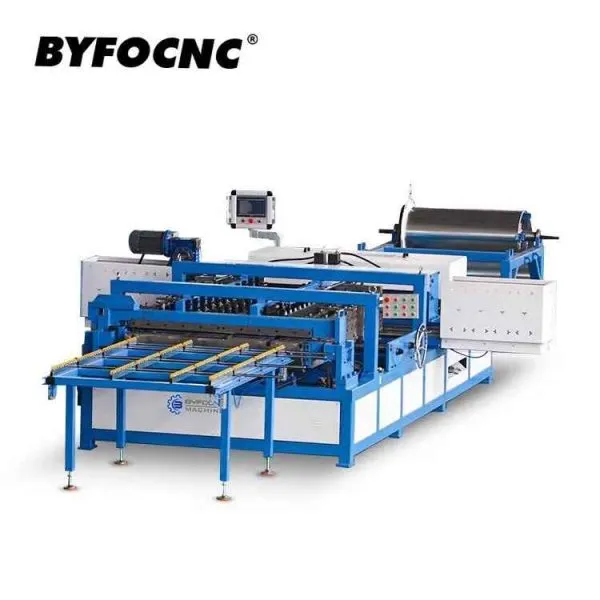
V. How Does BYFO Duct Equipment Support Green Building?
• High-precision forming: Tight joints, low air leakage rate → Reduced operating energy consumption
• Thin plate processing capability: Thinner plates can be used → Saves steel and reduces carbon emissions during transportation
• Integrated TDF flange: No angle steel required → Reduces auxiliary material consumption
• Optional internal bite: Smooth inner wall → Reduces resistance and dust accumulation
• Material compatibility: Galvanized steel, stainless steel, and aluminum sheets can all be processed → Supports single recyclable materials
VI. Conclusion
Green building is not just a “bonus”, but an increasingly important entry requirement for projects.
| Requirement | Duct system countermeasures |
| Energy saving | Circular spiral ducts are selected due to their low resistance and low air leakage. |
| Low carbon emissions | Thinner sheet metal, factory prefabrication, reduced welding. |
| Recyclability | Use galvanized steel/stainless steel/aluminum sheet, say goodbye to composite materials. |
Preparing to participate in green building projects? Contact BYFO with your material and specification requirements, and we’ll recommend a duct production solution that meets green standards for you.
Email: byfo@byfomachine.com
Whatsapp: (0086)18255536645