
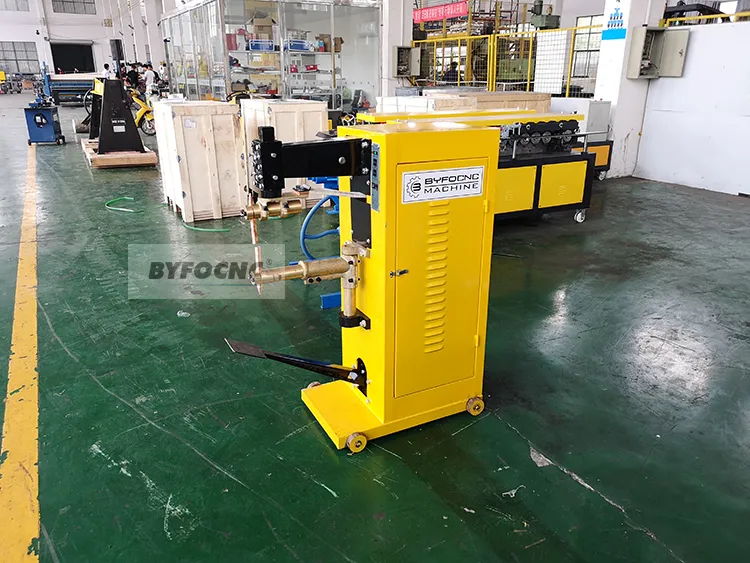
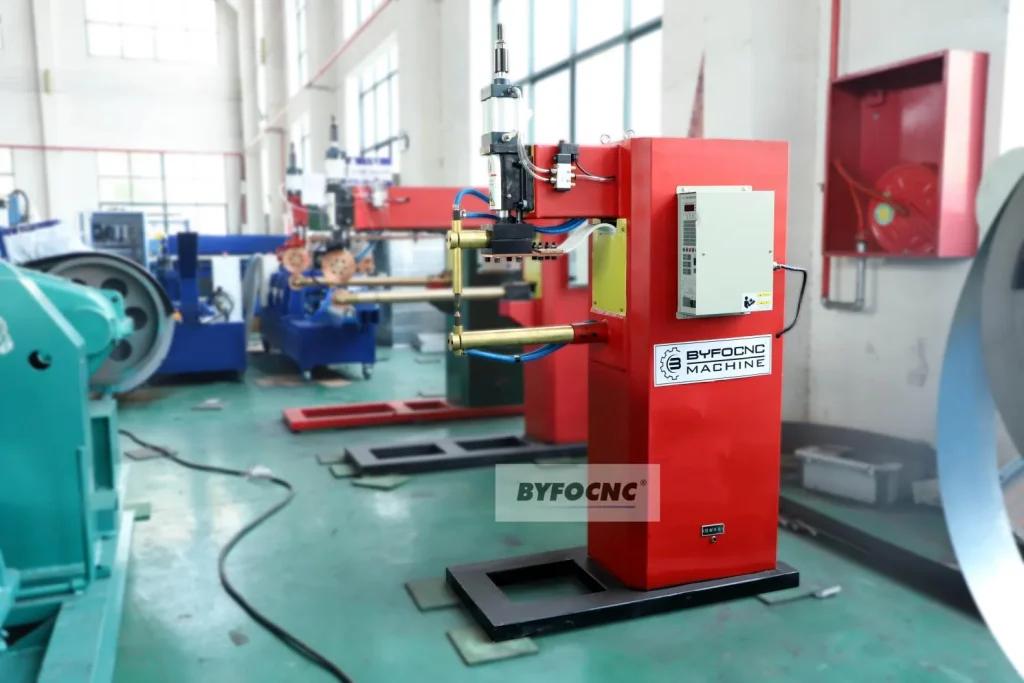
As a welding equipment widely used in metal connection, resistance spot welding machine is widely used in automobile manufacturing, home appliance production, aerospace and other fields due to its advantages of high efficiency, energy saving and high degree of automation. Whether it is mass production or precision welding, resistance spot welding machine occupies an important position in industrial manufacturing. However, any technical equipment has its limitations, and resistance spot welding machine is no exception.
Limited applicability of welding materials
The working principle of resistance spot welding machine is to locally heat the metal to the melting point through current and pressure to achieve welding. This method is very suitable for connecting thin sheet metal, especially steel materials such as cold-rolled steel, stainless steel, etc. However, for some materials that are more difficult to weld, such as aluminum alloys and copper alloys, the effect of resistance spot welding machine is not satisfactory.
Materials such as aluminum alloys and copper alloys have good conductivity, which means that they generate less heat when current passes through, resulting in poor welding effect. For such materials, it is difficult to achieve ideal welding quality even with high-power resistance spot welding machine. Therefore, resistance spot welding machine is not a universal choice for all metal materials, and the material selection is relatively limited.
Limited welding thickness, unable to cope with heavy-load joints
Although resistance spot welders can efficiently complete the welding of thin sheet metal, there are limitations on the thickness and joint strength of their welding. For metal materials exceeding a certain thickness, the welding effect of resistance spot welders may be greatly reduced because their heating area is small and it is difficult to provide enough heat for effective welding. Generally, resistance spot welding is suitable for welding metals with a thickness between 0.1mm and 6mm. Beyond this range, other welding methods such as MIG welding or TIG welding may be required.
In addition, the welding joints of resistance spot welders are mostly spot joints. Although they are suitable for occasions with small static loads, for joints that need to withstand large dynamic loads or complex stresses, the strength of spot welding may be insufficient and cannot meet the high-strength requirements. This is also the limitation of resistance spot welders in some special application fields.
High requirements for welding position, limited flexibility
The welding process of resistance spot welders requires precise electrode alignment and stable pressure application. Although the degree of automation is high, in actual applications, deviations in electrode position may lead to unstable welding quality and even affect the strength of welded joints. If the welded workpiece has a complex shape or is not in a fixed position, the operation will be more difficult and additional tooling equipment may be required to assist in positioning. This high requirement for the welding position limits the flexibility of the resistance spot welder and makes it less suitable for some non-standardized application scenarios.
In the actual production line, if the shape of the workpiece is irregular, special equipment adjustment and positioning tooling may be required, which not only increases the complexity of the operation, but also may reduce production efficiency and increase production costs.
Electrode wear problem
The electrode is a key component in the resistance spot welder, responsible for transmitting current to the welding point and pressing the workpiece by pressure. After long-term use, the electrode will be worn, resulting in an uneven electrode surface, which affects the welding quality. The main reason for electrode wear is frequent high-temperature heating and metal contact friction, especially in mass production, the speed of wear is more obvious.
After the electrode is worn, it needs to be replaced or reprocessed regularly, which not only increases the maintenance cost of the equipment, but also may affect the stability and continuity of the production line. Therefore, the problem of electrode wear is a challenge faced by resistance spot welders in large-scale production, and the electrode needs to be checked and replaced regularly.
High energy consumption problem
Although resistance spot welders are relatively efficient in the welding process, they need to pass a large amount of current to heat the metal contact points, so their energy consumption is relatively high when running at high load. Especially in large-scale production, the high energy consumption problem of resistance spot welders may lead to an increase in the operating costs of enterprises.
In order to solve this problem, some companies have begun to try to optimize the welding process and reduce unnecessary energy waste. Nevertheless, at the current level of technology, the energy consumption problem of resistance spot welders still exists, especially when long-term and high-intensity welding is frequently performed, the phenomenon of excessive energy consumption will be more obvious.
High operating skills requirements
Although modern resistance spot welders have a high degree of automation, their operation process still requires certain professional knowledge and skills. For example, operators need to be familiar with the regulation of current, the control of pressure, and the maintenance of electrodes. If they are not careful, the welding quality may be unqualified. Therefore, the use of resistance spot welders requires high training for operators, and those who have not been professionally trained may find it difficult to master precise operating skills.
In some applications that require high precision, the operator’s technical level and experience directly affect the welding quality, so companies often need to invest more training resources to ensure that operators can master the use of equipment.
Equipment cost and maintenance cost
The initial investment of resistance spot welding machines is large, especially for equipment that requires high power or high precision, the price may be higher. At the same time, the maintenance cost of the equipment cannot be ignored. In addition to the replacement and maintenance of electrodes, the equipment itself also needs regular inspection and maintenance to ensure its long-term stable operation. These maintenance costs increase the operating costs of enterprises to a certain extent.
Although the resistance spot welding machine has high working efficiency, in the long run, the investment and maintenance costs of the equipment are still a considerable burden. Especially in large-scale production, how to balance the equipment cost and welding quality is an issue that enterprises need to consider carefully.
The advantages and disadvantages of resistance spot welding machines coexist
Overall, resistance spot welding machines still occupy an important position in modern manufacturing. Its high efficiency and high degree of automation make it widely used in many industries, especially in the fields of automobiles and home appliances. However, like any technical equipment, resistance spot welding machines also have some shortcomings that cannot be ignored, including limited applicable materials, relatively low welding strength, high requirements for welding positions, and high energy consumption.
When choosing welding equipment, enterprises should consider the advantages and disadvantages of spot welding machines based on their own production needs, material types, product specifications and other factors, and choose the most suitable welding method. In high-strength, large-size, and complex-shaped welding tasks, resistance spot welding machines may not be able to fully meet the requirements. At this time, other welding methods, such as MIG welding, TIG welding, etc., may be better choices.
Through the analysis of the advantages and disadvantages of resistance spot welding machines, I believe that you can make more scientific and reasonable decisions during the purchase and use process, avoid unnecessary misunderstandings, improve production efficiency, reduce costs, and achieve better welding results.