
— A Complete Guide to Round Duct Production Equipment
Round ventilation ducts play an indispensable role in industrial ventilation, dust removal systems, kitchen smoke exhaust, and some commercial buildings due to their unique advantages such as low air flow resistance, high structural strength, and material efficiency. Unlike square ducts, the production process of round ducts focuses more on two core procedures: “rolling” and “seaming”. This article will provide you with a comprehensive analysis of various equipment required for the production of round ducts, helping you to build a professional round duct production line.
I. Characteristics and Production Overview of Round Ducts
Compared to square ducts, round ducts possess the following irreplaceable advantages:
| Key features | Advantages |
| Aerodynamic performance | Lower air resistance results in higher ventilation efficiency under the same cross-sectional area |
| Structural strength | The arc-shaped structure is uniformly stressed, enabling it to withstand higher pressure with the same plate thickness |
| Material savings | The shortest perimeter and most economical material usage under the same cross-sectional area |
| Good self-cleaning property | No dead corners, dust-resistant, suitable for high-cleanliness environments |
There are primarily two process paths for the production of round ducts:
1. Spiral duct technology: continuous winding and forming, capable of producing ducts of any length, with the highest efficiency
2. Straight seam rolling process: First, cut and lock form the plate, then roll and seam it. It is suitable for non-standard sizes and fittings such as elbows
II. Detailed Explanation of Core Equipment
1. Spiral duct machine – the “main force” in round duct production

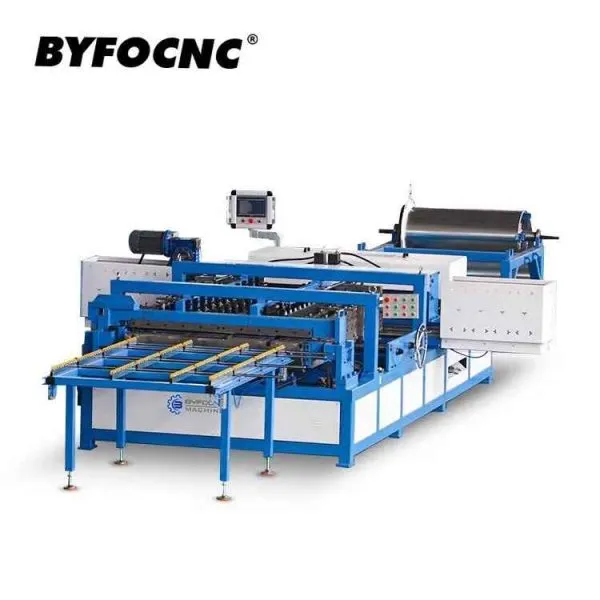
The spiral duct machine is a core equipment for professionally producing round spiral ducts. It can produce round ducts of any length by continuously winding and engaging the strip-shaped coil material.
Working Principle:
-After being leveled, the strip-shaped coil material is fed into the forming machine at a certain angle
-Special molds process the edges of the plates into a seaming shape
-The plate is spirally wound, with the seams automatically engaging
-Continuously produce round air ducts, which can be cut to the required length
Technical Specifications:
-Processing plate thickness: 0.5mm – 1.2mm (galvanized plate)
-Duct diameter range: 80mm – 1500mm (larger specifications can be customized)
-Production line speed: 3 – 5 meters per minute
-Seam form: outer seam (traditional type) or inner seam (with a flatter appearance)
Advantages: The spiral duct machine produces ducts with high strength, low air leakage rate, and customizable length, making it the preferred equipment for mass production of round ducts.
2. Rolling machine – transforms a flat plate into a cylinder

The rolling machine is a specialized equipment that rolls cut flat plates into cylindrical shapes, suitable for the production of round ducts, elbows, reducers, and other accessories using non-spiral processes.
Based on the number and structure of the rollers, the rolling machine can be classified into:
-Three-roller rolling machine: the most common type, with two lower rollers fixed and the upper roller adjustable, suitable for small and medium-sized diameter air ducts
-Four-roller rolling machine: It can pre-bending the two ends of the plate, achieving better rolling effect, suitable for thick plates and large diameter air ducts
Key performance indicators:
-Maximum plate rolling width: typically 1250mm or 1500mm
-Minimum rounding diameter: depends on the roller shaft diameter, typically ranging from 80-100mm
-Processing plate thickness: 0.5mm – 2.5mm (varying significantly across different machine models)
3. Seam closer machine – closing the seams of round ducts

The seam closer is used to press and secure the seams of the rolled plates, ensuring the sealing performance and structural strength of the air duct. It is typically used in conjunction with a rolling machine and a flange machine (for end flanges) to form a complete round tube production line.
4. Multi-functional lock machine – basic for forming edges of plates

Similar to the production of square ducts, the multi-function lock machine is also a fundamental equipment for the production of round ducts. It is used to process specific seaming shapes on the edges of the plates, preparing for subsequent rolling and seaming.
Common types of seams for round ducts:
-Single flat seam: used for longitudinal seams of ordinary round tubes
-C cleat: used for lateral connection of round ducts
-Pittsburgh lock: used for splicing of fittings such as elbows and tees
5. Flange forming equipment – connection system for round ducts
The connection of round ducts also requires a flange system, but unlike square ducts, there are mainly two types of flanges for round ducts:
A. Angle iron flange system
Roll the angle iron into a round shape, and then weld it into a flange ring for use in high-pressure systems or large-diameter air ducts.
-Angle iron rolling machine: It directly cold-bends angle steel or flat steel into a round shape, with an efficiency far higher than that of hot bending process
-Processable angle steel specifications: L25×3, L30×3, L40×4, etc
B. Common plate flange system (applicable to spiral ducts)
The two ends of the spiral duct can be directly formed into flange edges using specialized equipment, which can be used in conjunction with flat steel flange rings.
-Spiral duct flange machine: Roll out reinforcing ribs and flange edges at both ends of the spiral duct
-Cooperate with the flange ring rolling machine to produce matching flat steel flange rings
6. Plasma/Laser Cutting Machine – A Crucial Equipment for Precise Material Cutting

For special-shaped fittings such as elbows, tees, reducers, etc. of round ducts, CNC plasma cutting machines or laser cutting machines are essential equipment.
Features:
-Based on the CAD unfolding diagram, precisely cut the expanded shape of the accessory on the sheet material
-It can simultaneously complete the pre-cutting of the seaming edge and the beveling process
-Significantly enhance the precision and efficiency of accessory production
Recommended configuration: For small and medium-sized duct manufacturers, a 1530 specification (1500×3000mm workbench) CNC plasma cutting machine is a cost-effective choice.
7. Insert forming machine (S lock machine) – a specialized device for quick connection
The S lock machine is used to produce the “S” and “C” shaped inserts required for the connection of round duct inserts. This connection method eliminates the need for flanges, facilitates quick installation, and is suitable for low-pressure systems.
-It can be used in conjunction with a spiral duct machine
-Processing plate thickness: 0.5-1.0mm
-Production efficiency: Capable of continuous molding, with any length
III. Configuration Plan for Round Duct Production Line
Based on production scale and product positioning, different equipment configurations can be selected:
Option 1: Professional production line for spiral ducts (suitable for enterprises focusing on standard round tubes)
Core configuration:
-Spiral duct machine (main unit)
-Automatic length-fixing and cutting device
-Spiral duct flange machine (ends processing)
-Flange ring rolling machine (matching flat steel flange)
Production capacity characteristics:
-It can continuously produce round air ducts ranging from Φ80mm to Φ1500mm
-Daily production capacity: 500-1000 meters (depending on the diameter)
-Labor requirement: 2-3 people
Applicable scenarios: projects with high standardization, such as central air conditioning ducts, industrial ventilation, and dust removal pipelines.
Option 2: Comprehensive round tube production line (suitable for producing various round accessories)
Core configuration:
-CNC plasma cutting machine
-Multi-functional lock machine
-Three-roller rolling machine
-Seam closer machine
-Angle iron rolling machine
Production capacity characteristics:
-It can produce straight pipes, elbows, tees, reducers, etc. of various specifications
-High flexibility, suitable for non-standard projects and maintenance works
-Labor demand: 3-5 people
Applicable scenarios: engineering companies, duct accessory factories, and maintenance service providers.
Option 3: Spiral duct + plasma cutting combination line (versatile configuration)
Core configuration:
-Spiral duct machine
-CNC plasma cutting machine
-Rolling machine
-Seam closer machine
-Multi-functional lock machine
-Angle iron rolling machine
Capacity characteristics:
-Take into account both standard tube mass production and complex accessory manufacturing
-High equipment utilization rate and wide range of business scope
-Labor demand: 4-6 people
Applicable scenarios: Comprehensive duct processing factories, HVAC engineering companies.
IV. How to choose suitable round duct equipment
1. Clarify product positioning
If the main product is standard round ducts: prioritize the configuration of high-performance spiral duct machines
If focusing on accessories: invest heavily in plasma cutting machines and rounding machines
If both are to be considered: consider the comprehensive configuration of Option Three
2. Determine the processing range
| Parameter | Considerations |
| Diameter range | What are the standard minimum and maximum diameters? (e.g., Φ100-Φ800mm) |
| Sheet thickness | Is the main processing target thin plates (0.5-0.8mm) or medium-thick plates (1.0-1.5mm)? |
| Length requirement | What is the standard pipe length? (Typically 1.2-1.5 meters per section, while spiral ducts can be of any length) |
3. Evaluate automation needs
-Manual type: Low equipment investment, suitable for small-batch, multi-variety production
-Semi-automatic type: partial automation of processes, moderate efficiency, high cost-effectiveness
-Fully automatic model: PLC control, servo feeding, suitable for large-scale standardized production
4. Consider supporting facilities and expansion
-Is the selected equipment compatible with the existing equipment?
-Can it meet the needs of future product line expansion?
-Is it convenient to supply spare parts?
V. Summary and Suggestions
The equipment required for manufacturing round ventilation ducts has established a comprehensive technical system. Compared to square ducts, the production of round ducts focuses more on the roll-forming process, with spiral duct technology being its core productivity.
Suggestions for enterprises at different stages of development:
Start-ups/small-scale production:
-It is recommended to start with a multi-function lock machine and a manual three-roller rolling machine
-Undertake small-batch round tube and accessory business
-Gradually add equipment according to business needs
Growth-oriented enterprises:
-Select spiral duct machines or plasma cutting machines as core equipment based on the business focus
-Equipped with a rolling machine and a seam closer machine, forming a complete capability
-Consider implementing a certain degree of automation to enhance efficiency
Large duct manufacturers/professional producers:
-Dual-core configuration of spiral duct machine + plasma cutting machine
-Fully automated or semi-automated production lines
-Supporting flange cold rolling, inserts forming and other auxiliary equipment
Nanjing BYFO Machinery Co., Ltd. specializes in producing various types of duct equipment and provides comprehensive solutions, ranging from standalone equipment to fully automated production lines. From equipment selection to process guidance, we offer you a one-stop service. Whether you are a newcomer to the duct industry or a professional manufacturer seeking to upgrade your production capacity, feel free to contact us at any time for the most professional advice and equipment solutions.