
Sheet metal forming is an important link in the manufacturing industry, involving the manufacturing of various complex parts and products. To achieve high-quality and efficient sheet metal forming, a series of professional equipment and tools are required. This article will introduce in detail the equipment required for sheet metal forming.
Shearing machine
The shearing machine is the equipment required in the first sheet metal forming process. It can cut large metal sheets into required shapes and sizes to meet subsequent forming and processing needs. The shearing machine has the characteristics of high precision and high efficiency, which can greatly improve production efficiency and product quality.
Stamping machine
The stamping machine is a commonly used equipment in sheet metal forming. It stamps sheet metal into parts of various shapes and sizes by applying pressure. The stamping machine has the characteristics of high precision, high efficiency and high stability, which can greatly improve production efficiency and product quality.
Bending machine
A bending machine is a device used to bend metal sheets into various angles and shapes. It can achieve bending at different angles and shapes by adjusting the bending angle and bending strength. The bending machine has the characteristics of high precision, high efficiency and high stability, which can greatly improve production efficiency and product quality.
Laser cutting machine
Laser cutting machine is a commonly used equipment in sheet metal forming. It cuts metal sheets through laser beams and has the characteristics of high precision, high efficiency and low cost. Laser cutting machines can cut complex shapes with smooth cutting edges without the need for secondary processing.
Welding machine
A welding machine is a device used to weld multiple metal parts together. In the sheet metal forming process, welding machines are often used to weld individual parts together to form a complete metal product. The welding machine has the characteristics of high precision, high efficiency and high stability, which can greatly improve production efficiency and product quality.
In addition to the above equipment, sheet metal forming also requires other auxiliary equipment and tools, such as grinders, milling machines, drill presses, etc. The use of these equipment and tools can greatly improve the quality and efficiency of sheet metal forming, thereby meeting the needs of various fields. In general, with the development of manufacturing industry and the advancement of technology, the equipment and tools used in sheet metal forming will become more and more advanced, becoming more and more efficient, high-precision, and high-stability, which will provide a good foundation for the manufacturing industry. provide stronger support for development.
Air duct forming equipment
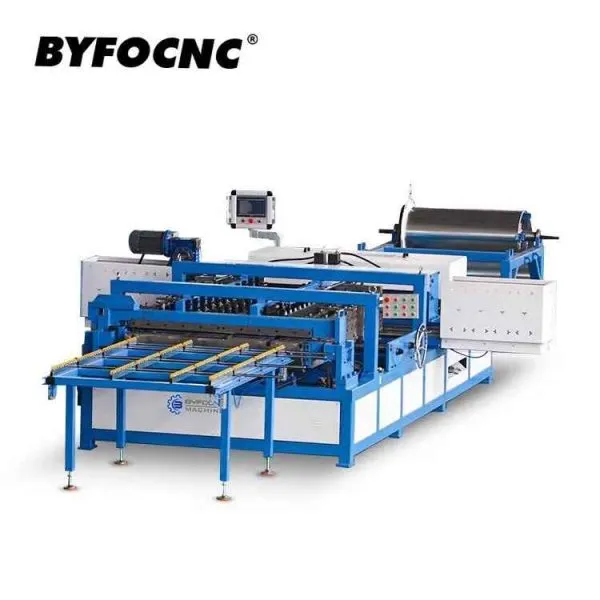
In addition to the general equipment required for sheet metal forming mentioned above, duct forming also requires specialized duct forming equipment.
These devices typically have the following features and capabilities:
- Special molds: Air duct forming equipment is usually equipped with special molds for processing metal sheets into air ducts of specific shapes and sizes. The design and manufacturing accuracy of the mold directly affect the shape and performance of the air duct.
- Bending and forming: Air duct forming equipment needs to have the ability to bend metal sheets into arcs or other curved shapes. This is usually achieved through the use of bending wheels or rollers, requiring precise control of the bending angle and curvature.
- Welding and splicing: For longer air ducts, multiple metal plates may need to be spliced together. Air duct forming equipment should have reliable welding or splicing functions to ensure the sealing and strength of the air duct.
- Size adjustment and calibration: After the air duct is formed, size adjustment and calibration are required to ensure that it meets the design requirements. The equipment should have corresponding mechanisms and functions to achieve precise dimensional control.
- Automation and intelligence: In order to improve production efficiency and reduce labor costs, air duct forming equipment should have the characteristics of automation and intelligence. For example, CNC technology is used to achieve precise processing control, and sensors and control systems are equipped to monitor and adjust the processing process in real time.
Air duct forming equipment is equipment specially used for processing metal air ducts. It has the functions of bending and forming, welding and splicing, size adjustment, automation and intelligence. These equipment can improve the production efficiency and accuracy of air duct molding and meet the needs of air ducts in different fields.
Types of air duct production equipment
The types of air duct production equipment can vary according to the material and purpose of use of the air duct, and can be mainly divided into the following types:
- Metal air duct production equipment: Metal air ducts are mainly used in ventilation and air conditioning systems and have the characteristics of high strength, durability, and fire protection. Metal air duct production equipment includes shears, punches, bending machines, welding machines, etc., which are used to cut, stamp, bend, and weld metal sheets into air ducts of the required shape.
- Non-metallic air duct production equipment: Non-metallic air ducts are usually made of fiberglass, PVC, PP and other materials, and are mainly used in ventilation and air conditioning systems. Non-metallic air duct production equipment includes plastic extruders, plastic calenders, coating equipment, etc., which are used to process non-metallic materials into air ducts of required shapes.
- Composite air duct production equipment: Composite air ducts are composed of two or more layers of materials. The inner layer is mostly fiberglass or PVC material, and the outer layer is mostly aluminum foil or steel plate. Composite air duct production equipment includes composite plate production lines, hot presses, laminating machines, etc., which are used to process multi-layer materials into composite air ducts of the required shape.
- Hand tools: In addition to automated production equipment, there are also some hand tools used in the production of air ducts, such as squares, compasses, cutting machines, electric drills, etc. These tools can be used for measuring, scribing, cutting, drilling and other operations on air ducts.
In short, different air duct production equipment is suitable for different materials and production scales, and it is crucial to choose equipment that suits your own production needs.
The fully automatic HVAC duct automatic line is an advanced production line used to automatically produce and process HVAC ducts. Such automated lines typically include multiple workstations, each equipped with specific machines and tools to complete different manufacturing and processing steps of the pipe.
In the fully automatic HVAC pipeline automatic line, raw materials are transported to the production line through the transmission system, and pass through cutting, bending, welding, grinding, cleaning and inspection stations in sequence. These stations can complete different tasks, such as cutting the length of the pipe, bending the angle and radian of the pipe, welding the joints of the pipe, grinding the surface of the pipe, cleaning the inside and outside of the pipe, inspecting the size and appearance of the pipe, etc.
The advantages of fully automatic HVAC duct automation lines include:
- Improve production efficiency: Automated production lines can quickly complete a large number of production tasks, avoiding the slow speed and low efficiency of traditional manual production methods.
- Reduce costs: Through automated production, the need for a large amount of manpower can be reduced, thereby reducing production costs. In addition, automatic lines can also reduce waste and defective products, further reducing costs.
- Improve product quality: The machines and tools on the automatic line can accurately complete various processing and inspection tasks, ensuring the quality and accuracy of pipelines.
- Improve the working environment: Automated production lines can reduce environmental pollution and noise, and can also reduce the impact on employees’ health.
The fully automatic HVAC pipeline automatic line is an efficient, precise and environmentally friendly production method that can increase production efficiency, reduce costs, improve product quality and improve the working environment.