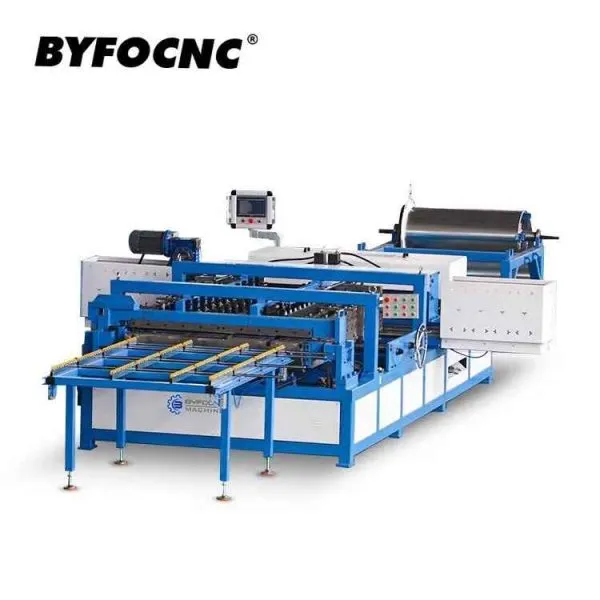


——BYFO technology analysis
In the production of spiral ducts, reinforcing ribs (spiral ribs) are a seemingly simple but crucial structural feature. It is not only a symbol that distinguishes spiral ducts from other ducts, but also directly determines the circumferential intensity, compressive intensity, material usage, and final cost of the duct.
The reinforcing rib design is too weak, and the duct is prone to deformation and instability during transportation, installation, or operation; If the reinforcing rib design is too strong, it means more material consumption and higher costs, resulting in resource waste. How to find the optimal balance between intensity and cost is a question that every air duct processing enterprise owner and engineer needs to seriously consider.
Based on years of experience in manufacturing spiral duct equipment and material mechanics analysis, BYFO company will deeply analyze the core principles and optimization strategies of reinforcing rib design for you.
1、 The role of reinforcing ribs: not just ‘good-looking’
The spiral protrusions (commonly known as “ribs”) on the spiral air duct are continuous ripples formed by the rolling of forming rollers on the sheet metal. Its main functions are four:
1.1 Increase circumferential intensity
When the air duct is subjected to external pressure (such as underground installation, negative pressure operation) or internal positive pressure, the pipe wall will undergo radial deformation. intensityening ribs is equivalent to adding a “skeleton” to the pipe wall, significantly improving the duct’s ability to resist deformation.
1.2 Increase axial stability
During long-distance installation, spiral ducts may experience axial bending due to their own weight or wind pressure. Spiral reinforcing rib ribs can disperse stress and enhance the overall rigidity of ducts.
1.3 Reduce material thickness
With the support of reinforced ribs, thinner sheets can be used to achieve the same intensity requirements, thereby reducing material costs.
1.4 Improving Airflow Characteristics
The influence of spiral ribs on the inner wall airflow is relatively small (compared to the corner vortex of rectangular ducts), but a reasonable rib height will not significantly increase resistance.
2、 Key design parameters for reinforcing ribs
The design of reinforcing ribs involves the following core parameters:
| Parameter | Definition | Unit | Typical range |
| Height of the rib (H) | Height of rib protrusion | mm | 2-8 |
| Distance of the rib (P) | The center distance between adjacent ribs | mm | 12-25 |
| Width of the rib (W) | Root width of the rib | mm | 3-6 |
| Shape of the rib | Trapezoidal, circular arc, rectangular | – | Trapezoidal/circular arc shape is most common |
| Angle of the rib | Angle between rib and axis | ° | Typically 45-60° |
Among them, reinforcing rib height and distance are the two parameters that have the greatest impact on intensity.
3、 The influence of reinforcing rib design on intensity
3.1 Relationship between reinforcing rib height and circumferential intensity
The circumferential intensity (EI) is proportional to the third power of the reinforcing rib height. In other words:
-Increase reinforcing rib height by 1 times → increase intensity by approximately 8 times
-Increase reinforcing rib height by 20% → increase intensity by approximately 73%
Example:
-Reinforcing rib height 2mm → benchmark intensity
-Reinforcing rib height 3mm → intensity approximately 3.4 times that of 2mm
-Reinforcing rib height 4mm → intensity approximately 8 times that of 2mm
Conclusion: Increasing the reinforcing rib height appropriately can greatly improve the intensity of ducts. But if the reinforcing rib is too high, it will increase the difficulty of forming and material stretching.
3.2 Relationship between reinforcing rib distance and intensity
The circumferential intensity is inversely proportional to the third power of the reinforcing rib distance. Namely:
-Reduce the reinforcing rib distance by 1 times → increase the intensity by about 8 times
-Reduce the reinforcing rib distance by 20% → increase the intensity by about 95%
Example:
-Reinforcing rib distance 25mm → benchmark intensity
-Reinforcing rib distance 20mm → intensity approximately 1.95 times that of 25mm
-Reinforcing rib distance 15mm → intensity approximately 4.6 times that of 25mm
Conclusion: Reducing the reinforcing rib distance (increasing the number of ribs) can also significantly improve intensity, but it will increase the amount of material used (because the unfolded length of the ribs is longer).
3.3 Influence of reinforcing rib shape
-Trapezoidal reinforcing rib: High rigidity, easy to form, most common
-Circular arc reinforcing rib: With low stress concentration, suitable for thin plates, but slightly lower intensity than trapezoidal reinforcing rib
-Rectangular reinforcing rib: The highest intensity, but the sheet is stretched too much and prone to cracking
4、 The impact of reinforcing rib design on material cost
Reinforcing ribs are formed by cold rolling and extruding protrusions on a flat plate, which causes plastic stretching of the plate. The higher the reinforcing rib and the smaller the reinforcing rib distance, the more plates are consumed per unit length of air duct.
4.1 Calculation method for material increment
Calculation formula for the unfolded width (material width) of spiral ducts (approximate):
L = π × D × (1 + K)
Among which:
-L: Material width required per unit length of air duct
-D: Diameter of air duct
-K: Material increment coefficient caused by reinforcing rib (related to reinforcing rib height and distance)
Typical K value reference:
| Reinforcing rib height (mm) | Reinforcing rib distance (mm) | Material increment coefficient K | Material increase per meter of duct |
| 2 | 25 | 0.02 | 2% |
| 3 | 25 | 0.045 | 4.5% |
| 4 | 25 | 0.08 | 8% |
| 3 | 20 | 0.056 | 5.6% |
| 3 | 15 | 0.075 | 7.5% |
4.2 Example of cost impact
Taking a galvanized sheet spiral air duct with a diameter of 500mm and a wall thickness of 0.8mm as an example:
-Theoretical material width without reinforcing rib: π× 500=1571mm
-Reinforcing rib height 3mm, distance 25mm: Material width ≈ 1571 × 1.045=1642mm
-Increase in plate area per meter: 0.071 m²
-Calculated at 5 CNY/m² for galvanized sheet: an additional cost of 0.36 CNY per meter
-Annual production of 100000 meters: Increased cost of 36000 CNY
If over designed (with a reinforcing rib height of 4mm and a distance of 15mm), the material increase can reach more than 10%, and the annual cost increase can reach 50000 to 80000 CNY.
5、 How to find the best balance point? ——BYFO optimization strategy
5.1 Select based on the diameter of the air duct
| Air duct diameter (mm) | Recommended reinforcing rib height (mm) | Recommended reinforcing rib distance (mm) |
| ≤200 | 2.0-2.5 | 20-25 |
| 200-500 | 2.5-3.0 | 20-25 |
| 500-1000 | 3.0-3.5 | 18-22 |
| 1000-1500 | 3.5-4.0 | 15-20 |
| >1500 | 4.0-5.0 | 12-18 |
Principle: The larger the diameter, the higher the required reinforcing rib height and the smaller the distance between ribs.
5.2 Select based on working pressure
| System pressure | Recommended reinforcing rib height (mm) | Recommended reinforcing rib distance (mm) | The plate thickness can be thinned |
| Low pressure (≤500Pa) | 2.0-2.5 | 25 | Benchmark |
| Medium pressure (500-1500Pa) | 2.5-3.0 | 20-25 | Can be thinned 0.05-0.1mm |
| High pressure (>1500Pa) | 3.0-4.0 | 15-20 | Can be thinned 0.1-0.15mm |
Key insight: By optimizing reinforcing ribs, thinner plates can be utilized. For instance, a medium pressure system originally requiring 1.0mm-thick plates may achieve sufficient intensity with 0.8mm-thick plates by densifying reinforcing ribs (reinforcing rib distance 20mm, height 3mm).
5.3 Economic analysis: reinforcing rib or thickening?
To increase the circumferential intensity of the air duct by 50%, two solutions are proposed:
| Solution | Measure | Material increase | Cost increase | Processing difficulty |
| A | Increase the sheet thickness by 0.1 mm | About 12% | Relatively high | Low |
| B | Increase reinforcing rib height from 2.5mm to 3.0mm | About 2-3% | relatively low | Low |
| C | Reduce reinforcing rib distance from 25mm to 20mm | About 3-5% | Medium | Medium |
Conclusion: Prioritizing the adjustment of reinforcing rib parameters (increasing reinforcing rib height or increasing reinforcing rib density) is more economical than increasing the thickness of the plate. Because increasing the thickness of the plate will linearly increase the material cost, while adjusting the reinforcing ribs will result in a smaller material increase.
5.4 Consideration of material differences
Galvanized sheet: Good plasticity, can accept higher reinforcing rib height (maximum 4-5mm)
Stainless steel: Large rebound, and the rib height should not exceed 3mm, otherwise the rebound will be severe and greater forming force will be required
Aluminum plate: Soft and easy to form, but low intensity. It is recommended to increase the reinforcing rib distance instead of increasing the reinforcing rib height
6、 The risk of excessive design
6.1 Material waste
As mentioned earlier, excessively high reinforcing rib height or dense reinforcing rib distance can lead to a 5% -10% increase in material usage, which is a considerable expense for large-scale production.
6.2 Difficulties in forming
When the rib height is too large (exceeding 4mm), the forming rollers of ordinary spiral air ducts may not be able to fully press out the rib shape, resulting in uneven rib height and cracking of the plate.
6.3 Transportation damage
Excessive reinforcing ribs will make the surface of the air duct more uneven, and during stacking and transportation, the top of the ribs is easily flattened or scratched, which in turn affects the appearance and anti-corrosion performance.
6.4 Unnecessary intensity
For general ventilation systems (low pressure, non buried), excessive circumferential intensity has no practical significance and only increases costs.
7、 The advantages of BYFO reinforcing rib forming technology
7.1 High precision forming roller
The forming rollers of the BYFO spiral duct machine are made of GCr15 bearing steel, which has undergone precision CNC processing and heat treatment. The rib height error is controlled within ± 0.1mm to ensure that the reinforcing rib size of each air duct is consistent.
7.2 Adjustable reinforcing rib height design
The equipment is equipped with a quick adjustment mechanism, which can adjust the rib height within the range of 2.0-4.5mm without changing the mold, making it easy to switch quickly according to different orders.
7.3 Multiple reinforcing rib distance options
By replacing the gear set, different rib distances can be selected within the range of 12-30mm to meet various needs from low pressure to high pressure, small duct diameter to large duct diameter.
7.4 Anti cracking design
The rib profile of the forming roller adopts a circular arc transition design to avoid sharp angle stress concentration. Even when used for stainless steel or high hardness materials, it can effectively prevent plate cracking.
7.5 Material increment control
The forming process of BYFO equipment has been optimized to control the material increment coefficient K at the lowest level while ensuring intensity, helping customers save raw material costs.
8、 Optimization case: Practice of a certain air duct factory
Background: A medium-sized air duct processing factory mainly produces galvanized sheet spiral air ducts with diameters of 300-800mm for commercial building air conditioning systems. The original design used a reinforcing rib height of 3.5mm and a reinforcing rib distance of 20mm.
Problem: The material cost is high, and customers have reported that the intensity of the air duct is excessive (there has never been any deformation problem).
BYFO optimization suggestions:
-Diameter ≤ 500mm: The reinforcing rib height is reduced to 2.8mm, and the reinforcing rib distance is maintained at 20mm
-Diameter 500-800mm: Maintain the reinforcing rib height of 3.2mm and increase the reinforcing rib distance to 22mm
Result:
-The average material increment has decreased from 7% to 4.5%
-Annual output of 200000 meters, saving approximately 5000 square meters of galvanized sheet
-Annual material cost savings of approximately 25000 CNY
-The customer has no intensity-related complaints
9、 Conclusion
The reinforcing rib design of spiral ducts is a technical task that requires precise calculation and adaptation to local conditions.
-Intensity and cost are not in opposition, but can be balanced through scientific design
-Reinforcing rib height is the most sensitive parameter affecting intensity, but being too high can waste materials and increase the difficulty of forming
-Dense reinforcing distance can also improve intensity, but it will also increase material consumption
-Prioritizing the adjustment of reinforcing ribs rather than increasing the thickness of the plate is a more economical strategy
-Different diameters, pressures, and materials should have different combinations of reinforcing rib parameters
For duct processing enterprises, mastering the optimization design ability of reinforcing ribs means:
-Reduce material costs by 3% -8%
-Enhance product competitiveness
-Avoid losses caused by “over design” or “under design”
BYFO not only provides high-performance spiral duct machines, but is also committed to helping customers master the core technology of reinforcing rib design. Our technical team can provide you with free consultation on optimizing reinforcing rib parameters. Based on your product specifications and usage scenarios, we recommend the most economical combination of reinforcing rib height and distance.
Want to optimize your spiral duct reinforcing rib design?
Welcome to contact the BYFO technical team for professional parameter calculation and cost analysis services.